
In long-term investing, compounding enables you to earn returns on returns already generated. Given enough time, this can have a powerful effect on wealth creation. However, long-term outcomes are not solely influenced by the positive returns an investment earns; they are also influenced by the losses it avoids when markets weaken. Over time, limiting losses while still participating in market gains can preserve more capital for future growth and may reduce the time spent recovering. Drawing on the Allan Gray Balanced Fund’s experience across multiple market downturns, Thandi Skade examines how this relationship has played out.
Compounding holds a near-mythical status in long-term investing. It is typically explained as returns generating further returns, which, over time, can accelerate growth. While true, this only tells part of the story.
Investment returns are rarely delivered in a straight line. Periods of positive performance ahead of the benchmark (outperformance or alpha) are often interspersed with periods of weaker performance as markets move through different cycles. For investment managers, this means that identifying opportunities for growth is only one half of the equation; managing the downside risk that erodes accumulated gains forms the other half.
Participating in growth remains essential to building long-term wealth, but so, too, is remaining resilient when markets become more challenging.
Drawdowns, which are periods when an investment delivers negative returns, reduce the capital available for future growth. The investment must first regain the value lost before it can begin creating new wealth. Beyond potentially depleting your capital base, drawdowns also come with a time cost: Every month a portfolio spends recovering from losses is a month that is not spent compounding from its previous peak.
The time to recovery comes at a cost
The effect of a loss extends beyond the immediate decline in value because losses and gains are not symmetrical: A 10% loss requires an 11.1% gain to recover, while a 50% loss requires a 100% gain. The larger the decline, the greater the subsequent return required, because that return is earned from a smaller capital base, and positive returns are initially rebuilding lost value, not creating new wealth.
How long it takes for the investment to return to its prior peak also influences long-term outcomes. While smaller losses don’t necessarily guarantee a faster recovery, the returns that follow ultimately determine how long recovery takes.
Compounding needs growth and participation
If losses matter to long-term outcomes, it might seem logical to want to avoid risk altogether. However, an investment that avoids market risk may sacrifice the growth needed to achieve a long-term goal. Equally, pursuing growth without regard for downside can expose accumulated wealth to setbacks that require substantial return and time to repair. It is a balancing act.
The Allan Gray Balanced Fund provides a useful case study of how participating in growth while limiting losses can support long-term compounding.
How the Allan Gray Balanced Fund participates in growth while limiting losses
One way to assess whether an investment successfully balances growth and downside risk protection is to consider how much it participates in rising markets and how much it loses when markets fall. The Allan Gray Balanced Fund aims to create steady, long-term wealth for investors by balancing income generation, capital growth and risk of loss across a diversified selection of asset classes. Its objective is to outperform the average performance of similar unit trusts without taking on additional risk.
Comparing the Allan Gray Balanced Fund returns with those of the FTSE/JSE All Share Index (ALSI) during rising and declining equity market months provides a view of how it has participated in market growth and limited losses.
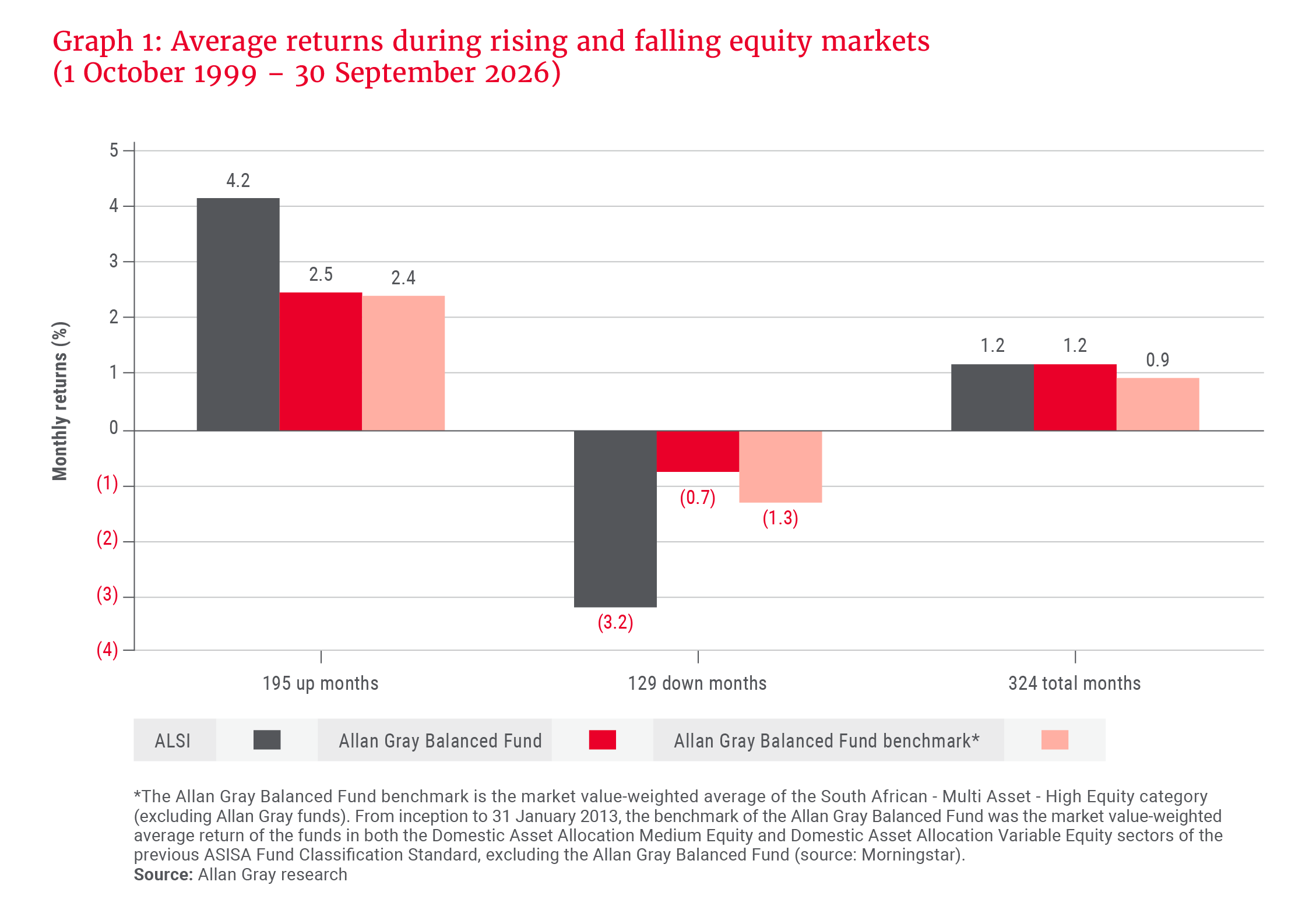
Over the period from 1 October 1999 to 30 September 2026, the Allan Gray Balanced Fund generally returned less than the market in months when the ALSI returns were positive, but it also experienced substantially less downside when markets declined. As shown in Graph 1, during the ALSI’s 195 up months, the Allan Gray Balanced Fund delivered an average monthly return of 2.5%, compared with 4.2% for the ALSI. During the ALSI’s 129 down months, however, the Allan Gray Balanced Fund declined by an average of just 0.7%, compared with 3.2% for the ALSI. It also delivered positive returns in 49 of the ALSI’s 129 negative months.
In other words, the Allan Gray Balanced Fund traded some upside participation for materially better downside protection. This means that a larger portion of its accumulated capital remained invested during difficult periods, reducing the amount of future growth needed to recover earlier losses.
... a smaller drawdown can preserve more capital and leave less ground to recover.
Relative to the ALSI, the Allan Gray Balanced Fund participated in just over half of the market’s gains when share prices were rising, but experienced only around a quarter of the losses when markets were falling. It also captured more of the ALSI upside and less of the ALSI downside compared to its benchmark.
The monthly return pattern offers another perspective. Over the 324 months from 1 October 1999 to 30 September 2026, the Allan Gray Balanced Fund delivered positive returns in 229 months, compared with 195 months for the ALSI.
What can past drawdowns teach long-term investors?
The importance of preserving capital becomes especially apparent during major market downturns, when losses can significantly increase both the return required to recover and the time spent doing so. The dot-com decline, the global financial crisis (GFC) and the COVID-19 pandemic disrupted markets in different ways. Each period offers a different perspective on the relationship between the size of a loss, the gain required to recover and the time taken to regain a previous peak.
During the dot-com decline, the Allan Gray Balanced Fund experienced a materially smaller drawdown than both its benchmark and the ALSI, declining by 12.5%, compared with 19.2% for its benchmark and 27.6% for the ALSI. It therefore needed a smaller gain to recover – 14.3%, compared with 23.8% and 38.1% for its benchmark and the ALSI respectively. It recovered to its previous peak in four months, compared with nine months for both comparators. In this instance, losing less left more capital invested, less ground to make up and less time spent recovering.
The GFC was a more challenging test. The Allan Gray Balanced Fund declined by 15.4% between 22 May and 20 November 2008, while the ALSI declined by 45.4% over the same period. To recover to its previous peak, the Allan Gray Balanced Fund needed to gain 18.2%, compared with the 83.0% gain required by the ALSI. The Allan Gray Balanced Fund regained its previous peak in August 2009, more than a year before the ALSI did, in November 2010. It also recovered ahead of its benchmark.
This illustrates how a smaller drawdown can preserve more capital and leave less ground to recover. It also shows why both the absolute size of a loss and the loss relative to the market matter. Losing less may create better conditions for an earlier recovery, but it does not guarantee the fastest recovery in every market environment. The returns that follow, which are derived from asset allocation and stock selection, contribute to long-term outcomes.
... limiting losses lowers the return required to recover and preserves a larger capital base for future growth.
This was evident during the COVID-19 pandemic. The Allan Gray Balanced Fund’s maximum drawdown was 25.4% between 20 January and 23 March 2020, compared with 23.3% for its benchmark over the same period. While the Allan Gray Balanced Fund did not limit losses relative to its benchmark during this drawdown, it still declined materially less than the ALSI, which fell by 35.2%. All three recovered to their previous peaks within eight months.
Taken together, these periods reinforce the fact that limiting losses lowers the return required to recover and preserves a larger capital base for future growth.
Preserving the conditions for long-term compounding
Losing less and therefore compounding from a larger base has a meaningful effect on long-term outcomes. The Allan Gray Balanced Fund’s long-term returns provide an illustration of this principle.
Graph 2 compares the outcomes of a hypothetical R100 000 investment in the Allan Gray Balanced Fund, its benchmark and the ALSI from 1 October 1999 to 30 September 2026.
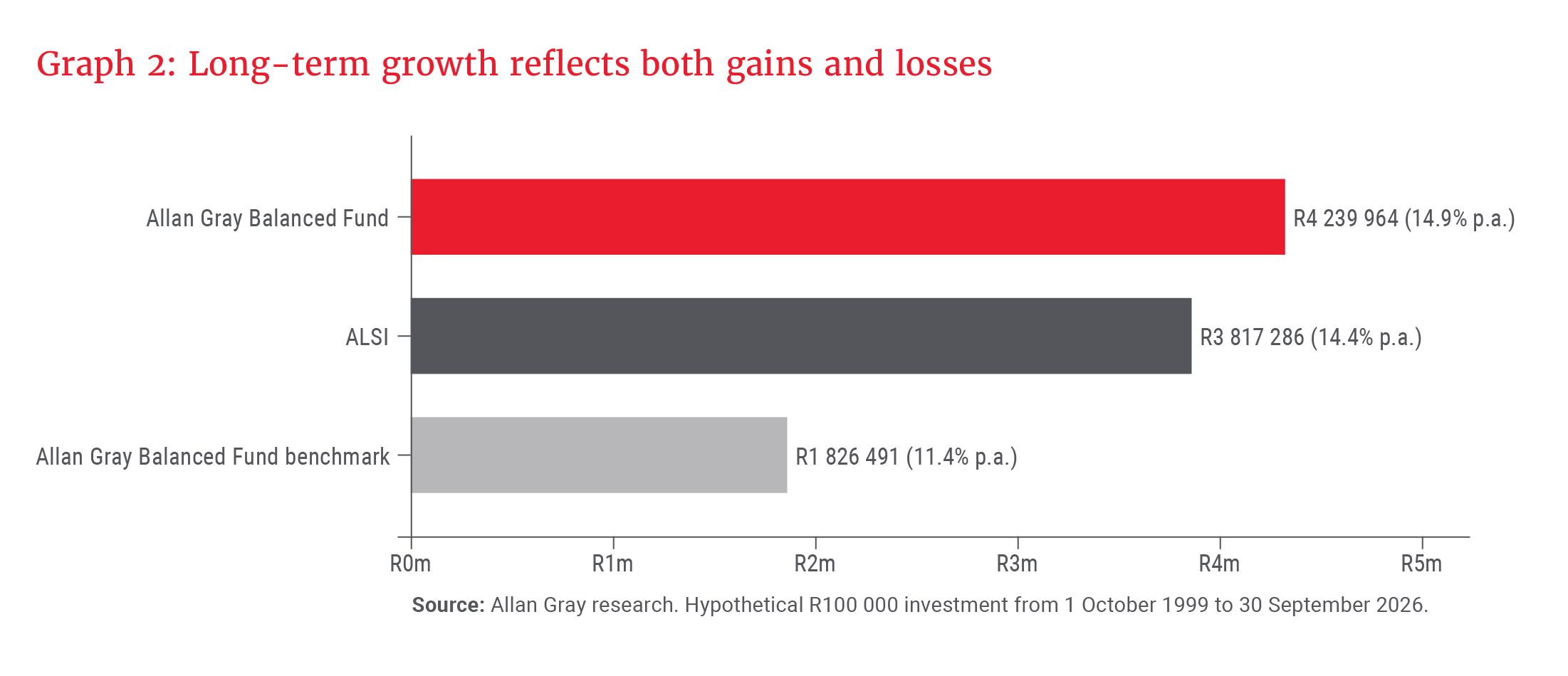
Over the full period, the Allan Gray Balanced Fund outperformed both its benchmark and the ALSI. It did not need to match every equity market rally to achieve this outcome. Participating in growth was important, but so was limiting the losses when markets declined. Asset allocation, stock selection and the order in which returns occurred also contributed to its long-term performance.
What should long-term investors take from this?
Compounding is often associated with the positive return periods experienced by an investment. However, long-term outcomes are shaped just as much by what happens when markets weaken. The losses that you experience along the way affect the capital available for future growth and the return required to recover. Participating in growth remains essential to building long-term wealth, but so, too, is remaining resilient when markets become more challenging. That is the overlooked side of long-term compounding.
- 2026 Q3 Comments from the Chief Operating Officer by Mahesh Cooper
- Changing offshore investment limits: A solution looking for a problem by Sandy McGregor and Mattew Patterson
- Navigating setbacks and successes at Sun International by Pieter Koornhof
- Orbis Global Balanced: The quiet compounders by Mark Dunley-Owen
- The patience paradox: The challenge of long-term investing by Daniella Bergman
- A belief that business can and should be a force for good by Mahesh Cooper
- Long-term lens: Seeing through the smoke and mirrors by Simon C. Marais
To view our latest Quarterly Commentary or browse previous editions, click here.