
A long-term mindset is essential to successful investing, but staying invested through difficult periods is not always easy. Investors do not only experience the final return – they must live through the ups and downs along the way. Managing that journey matters because large declines can be uncomfortable and make it harder to remain invested. Using the Allan Gray Balanced Fund to illustrate his points, Mthobisi Mthimkhulu helps us understand what it means to navigate uncertainty and make better decisions to get the most out of our investments over time.
Markets are rarely calm. Political uncertainty, economic slowdowns, global conflict, inflation fears and rapid technological change dominate headlines. These events trigger strong emotional responses: fear when markets fall, excitement when they rise, and anxiety about whether to act.
The temptation is often to respond: to change course, switch strategies or move to what feels “safe”. While these reactions are human, they can undermine long-term investment outcomes.
Prioritise perspective over prediction
Although current conditions may feel unusual, uncertainty is not new. A look at the past 25 years, divided into five-year periods, as illustrated in Figure 1, shows that every period has faced its own set of concerns. What changes is not the presence of uncertainty, but its source.
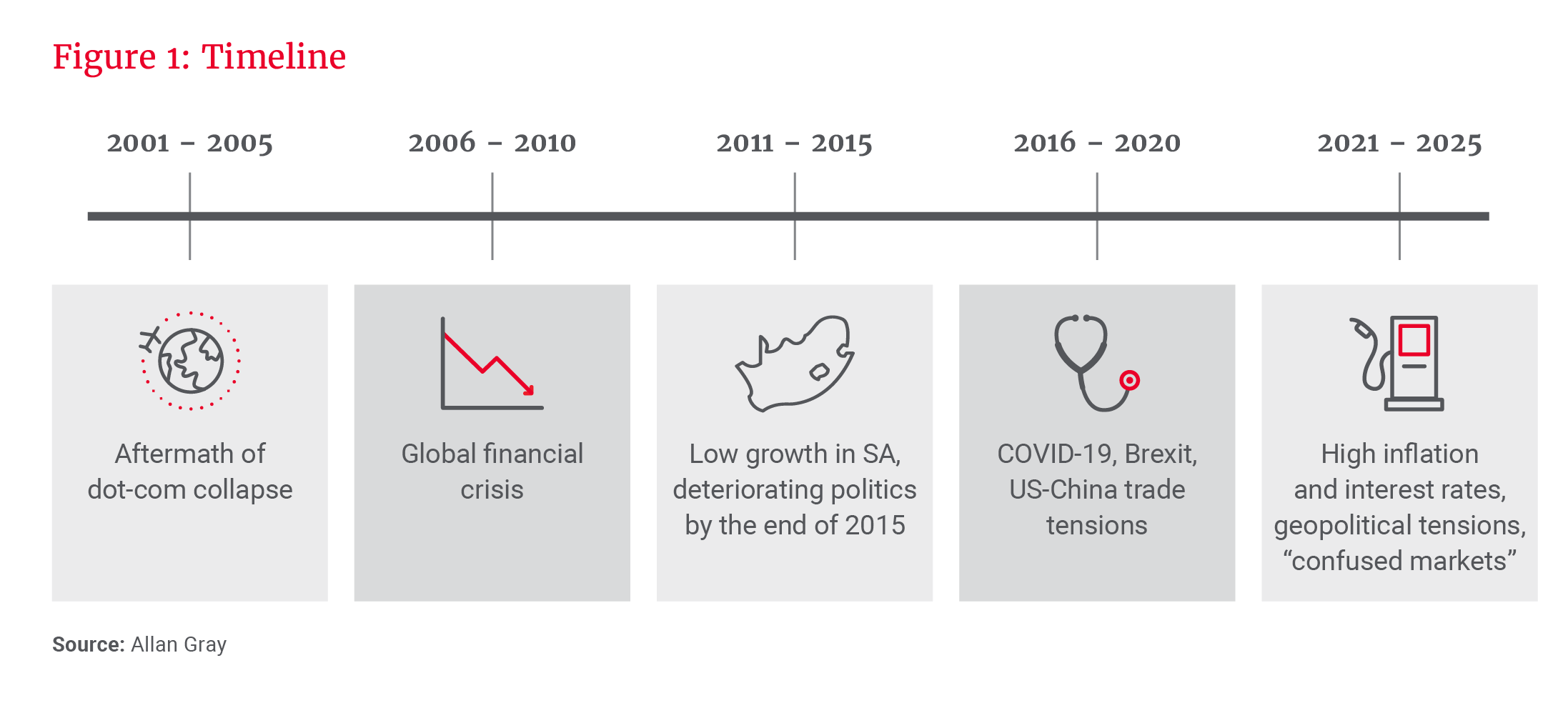
This perspective is important. Treating each new uncertainty as exceptional increases the risk that short-term concerns begin to dominate long-term decisions.
Adopt a long-term mindset
At Allan Gray, we accept that uncertainty is a permanent feature of markets. Rather than trying to predict short-term outcomes, we focus on understanding what assets are worth over time based on their underlying fundamentals. This provides an anchor for decision-making, even when conditions feel unsettled.
Importantly, periods of uncertainty can create opportunities. When fear is elevated, investors often sell broadly, pushing down the prices of both weaker and stronger assets.
For patient, value-orientated investors, this can create opportunities to invest in quality assets at more attractive prices.
Over time, markets have rewarded those who stayed invested and allowed compounding to do its work. Compounding is powerful precisely because it requires time. Interrupting the process by moving in and out of markets can undo years of progress.
Long-term investing requires discipline: staying invested when headlines are negative … and ensuring decisions are guided by a clear plan rather than short-term discomfort.
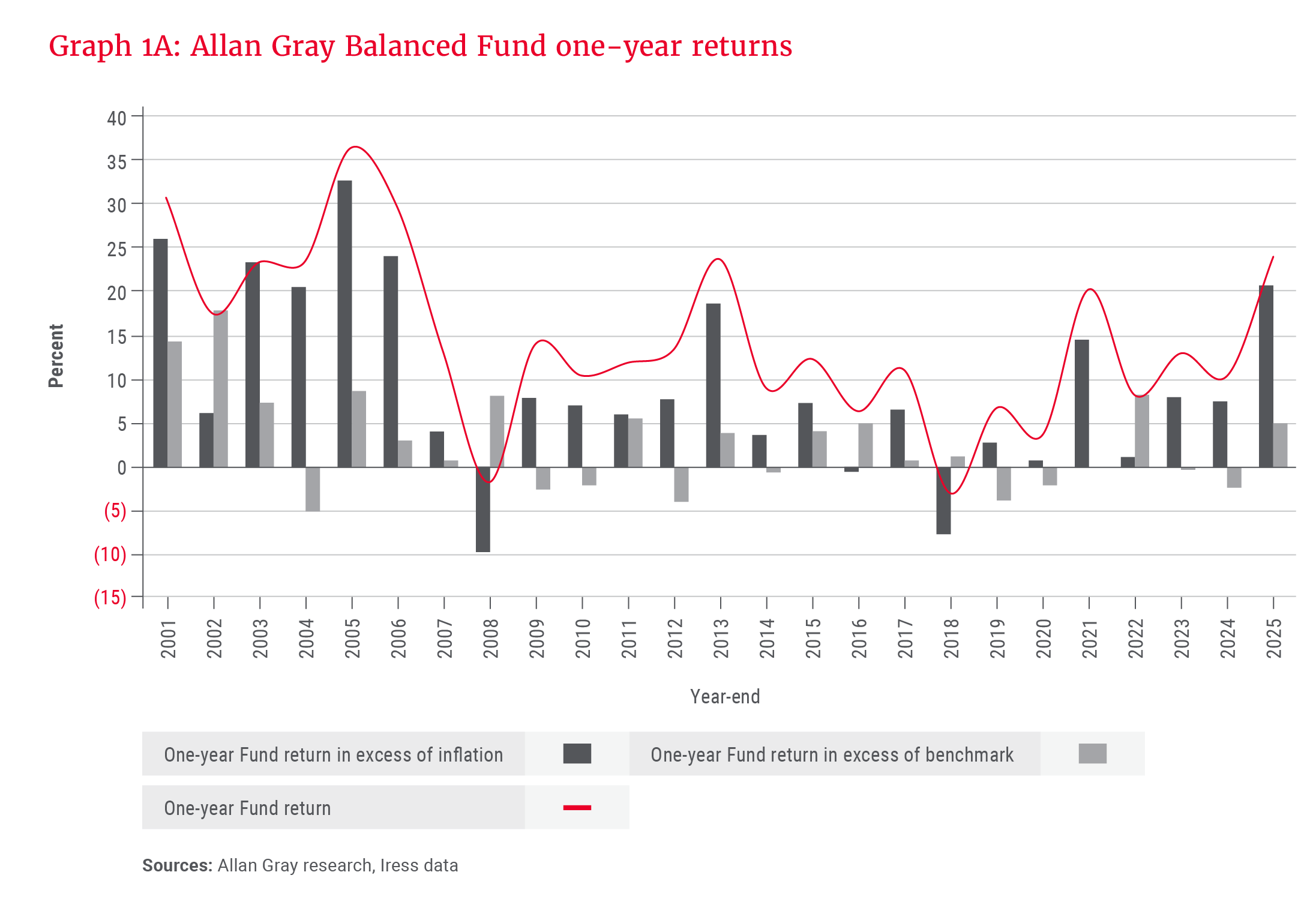
This is reflected in the Allan Gray Balanced Fund’s performance. Over the 25 years to the end of 2025, the Fund returned 14.3% per year, but as shown in Graph 1A, those returns have not come in a straight line, with some years experiencing stronger performance, and others experiencing weaker performance. However, it is the combination of these shorter periods and staying the course that drives long-term outcomes.
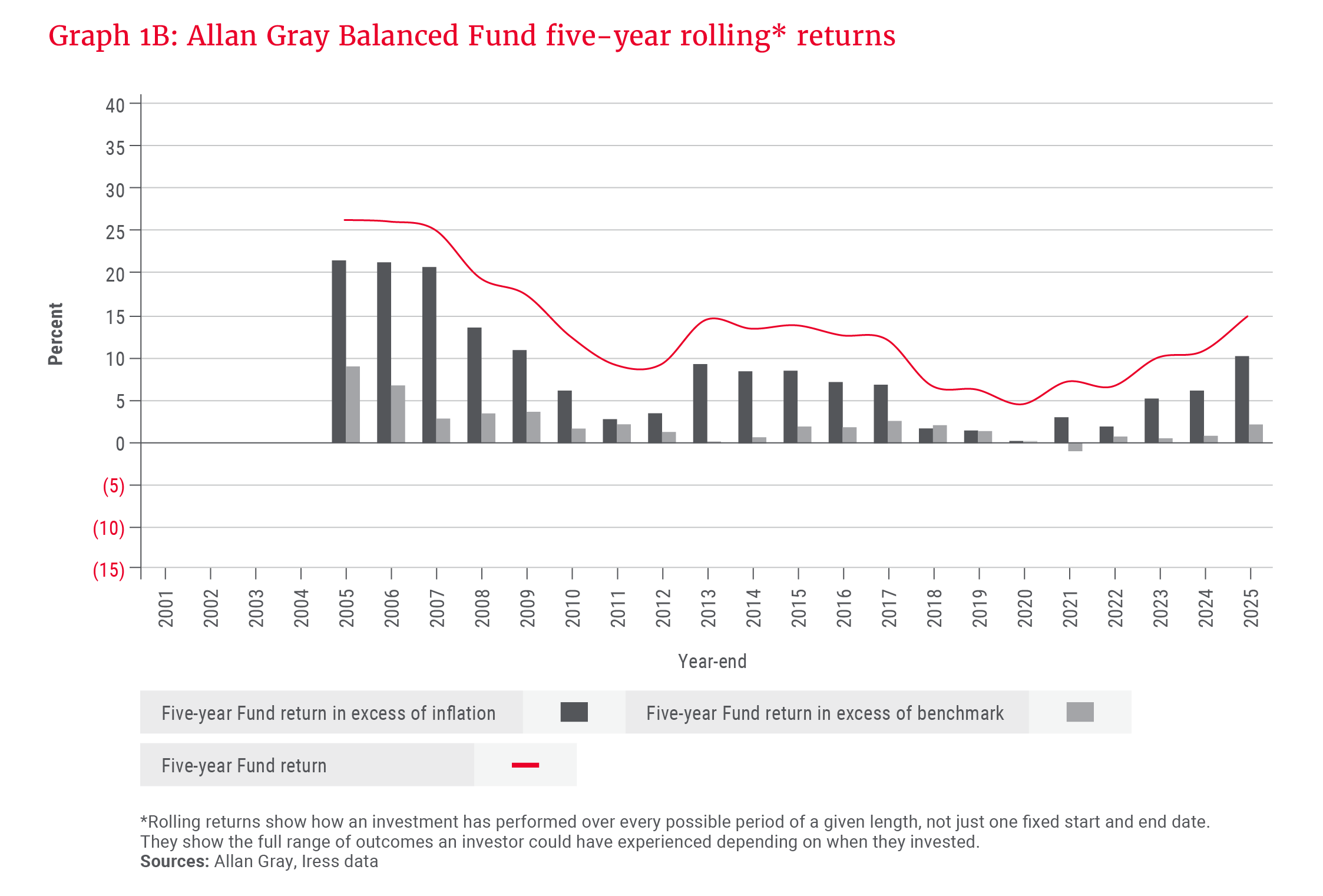
As shown in Graph 1B, the annualised five-year rolling returns at the end of each year are a lot less volatile, with the Fund’s annualised five-year returns exceeding inflation at the end of all of the periods and exceeding the benchmark at the end of all but one of the periods (2021). All in all, if you had invested R10 000 at the start of 2001, you would have R283 598 in the Fund (14.3% per year), R152 934 in the benchmark (11.5% per year) and R36 137 if you just kept up with inflation (5.3% per year).
Diversify to help manage the journey
Diversification plays an important role in portfolio construction. By spreading investments across asset classes, regions and sources of return, a portfolio becomes less dependent on any single outcome. While diversification does not eliminate risk or the discomfort that can accompany market volatility, it can help reduce the impact of any one event or market cycle.
The Allan Gray Balanced Fund invests across shares, bonds, property, commodities and cash, with the flexibility to invest up to 45% offshore. This diversification is complemented by a disciplined valuation-based investment approach – buying assets at attractive prices, avoiding areas where risks are not adequately rewarded, and repositioning the portfolio as opportunities emerge. Together, these elements seek to protect capital during difficult market conditions while still allowing investors to participate meaningfully when markets rise.
The outcome of this approach can be seen in Graph 2, which compares the average monthly returns of the market, represented by the FTSE/JSE All Share Index (ALSI) (dark grey bars), the Allan Gray Balanced Fund (red bars) and the Balanced Fund benchmark (pink bars) during rising and falling market environments, as well as over the full period from October 1999 to June 2026.
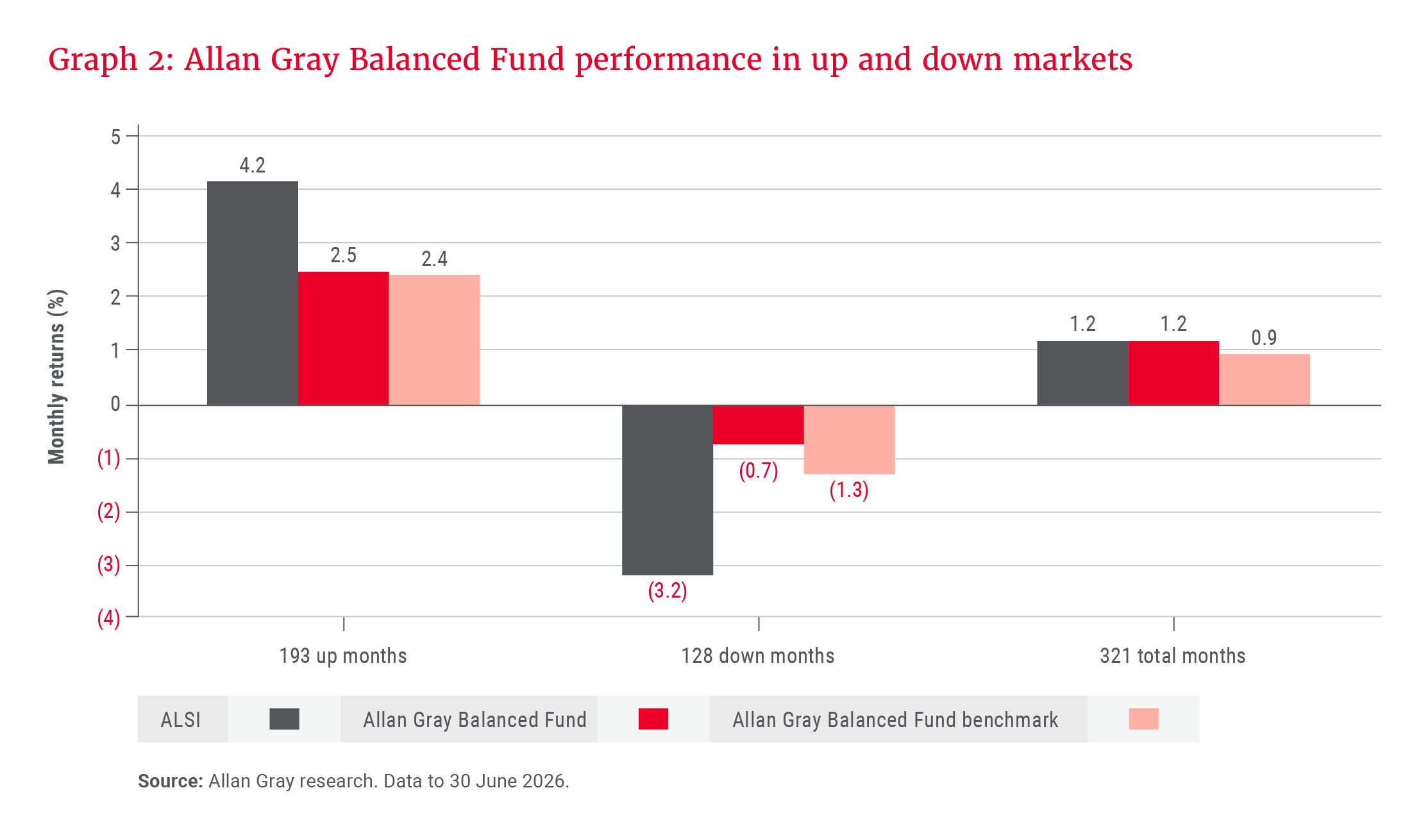
Although past performance is not a guarantee of future results, the graph highlights an important characteristic of the Fund’s historical performance: During rising market months, the Fund participated meaningfully in market gains; during falling market months, it experienced materially smaller declines than both the broader equity market and its benchmark. While the ALSI declined by an average of 3.2% in down months, and the benchmark declined by 1.3%, the Fund declined by 0.7% on average.
This pattern reflects the cumulative impact of the Fund’s investment philosophy over time: diversification across assets and geographies, disciplined asset allocation, careful security selection and a valuation-driven approach. By limiting the extent of losses during difficult periods while still participating in periods of market strength, the Fund has been able to compound returns effectively over the long term.
For investors, a smoother return profile can make the investment journey more manageable and increase the likelihood of remaining invested long enough to benefit from the power of compounding.
Avoid the real risk: behaviour
Individual investors face a range of risks, including not taking on enough risk to beat inflation, and not adequately diversifying. However, perhaps the greatest threat to long-term investment success is behaviour. Acting on fear, following the crowd, or constantly changing decisions can erode returns far more than market volatility itself. This leads to the “behaviour gap” – the difference between the return an investment delivers and what an investor actually experiences.
The challenge is bearing in mind that the best periods often follow the worst.
This gap often arises from well-intentioned decisions, such as moving out of the market during uncertainty, waiting for clarity before investing, or switching after periods of weak performance. The challenge is bearing in mind that the best periods often follow the worst. Stepping out at the wrong time can mean missing the recovery. For example, missing just the five strongest months in Graph 2 (due to moving out of the market following a period of negative return) would have reduced a R10 000 initial investment in the Allan Gray Balanced Fund from R422 255 (for investors who stayed invested) to R284 634 (for investors who missed the top five months and moved into a low-risk alternative).
Long-term investing requires discipline: staying invested when headlines are negative, avoiding overconfidence when markets are strong, and understanding the reasons for periods of underperformance. It also requires assessing performance over appropriate time horizons and ensuring decisions are guided by a clear plan rather than short-term discomfort.
Rather than reacting to every market movement, it is more effective to focus on what you can control: your behaviour, selecting a well-diversified portfolio aligned with your risk profile and goals, and staying the course over the investment horizon required to achieve your objective.
Align your investments with your goals
Investing ultimately supports real-life outcomes – financial independence, retirement security, education funding and peace of mind. Plans may need to be adjusted as circumstances evolve, but sound principles should remain constant.
Long-term investing is not passive or complacent – it is deliberate and often uncomfortable. In a world that rewards immediacy, patience becomes a competitive advantage. Meaningful outcomes take time and are rarely achieved in a straight line.
At Allan Gray, this belief has guided our approach for decades. Markets will continue to surprise, but the discipline of long-term investing remains as relevant as ever.
- 2026 Q2 Comments from the Chief Operating Officer by Mahesh Cooper
- What you own in this crazy world by Duncan Artus
- Developed market government borrowing costs are at a 20-year flashpoint by Thalia Petousis
- Managing risk in bullish markets by Jeff Tshikhudo
- Orbis Global Cautious: A disciplined approach to risk and return by Mark Dunley-Owen
- Your retirement, your choices: Making sense of the options by Richard Carter
To view our latest Quarterly Commentary or browse previous editions, click here.