
We base investment decisions on our assessment of the long-term economics of each underlying business and the risk of permanent capital loss. Jeff Tshikhudo considers recent moves in precious metal share prices, and the opportunities and risks they present for long-term investors.
For long-term investors, the risk of permanent capital loss tends to rise during bullish markets. Strong performance often draws investors in just as valuations become more demanding. Recent moves in precious metal shares provide a useful example, as this narrow segment of the market delivered outsized returns compared to the average South African share in 2025. Metal prices rose sharply, lifting company valuations and index weights, but the future pathway of those prices remains uncertain. In this environment, being disciplined about how much we invest is one way we seek to protect clients’ capital.
Precious metals outshine the rest
Over the 12 months to the end of June 2026, JSE-listed equities delivered strong returns, with South African equities rising 18.4% in rand terms, ahead of the 12.3% return from global equities. The performance, however, was uneven. For the six months from 1 July to 31 December 2025, the FTSE/JSE All Share Index (ALSI) returned 22%. As shown in Table 1, a large portion of that return came from precious metal mining companies, which contributed 61% of the ALSI’s total return. When most market gains come from only a handful of companies or sectors, investors become increasingly exposed to a single underlying driver – in this case, the price of precious metals.
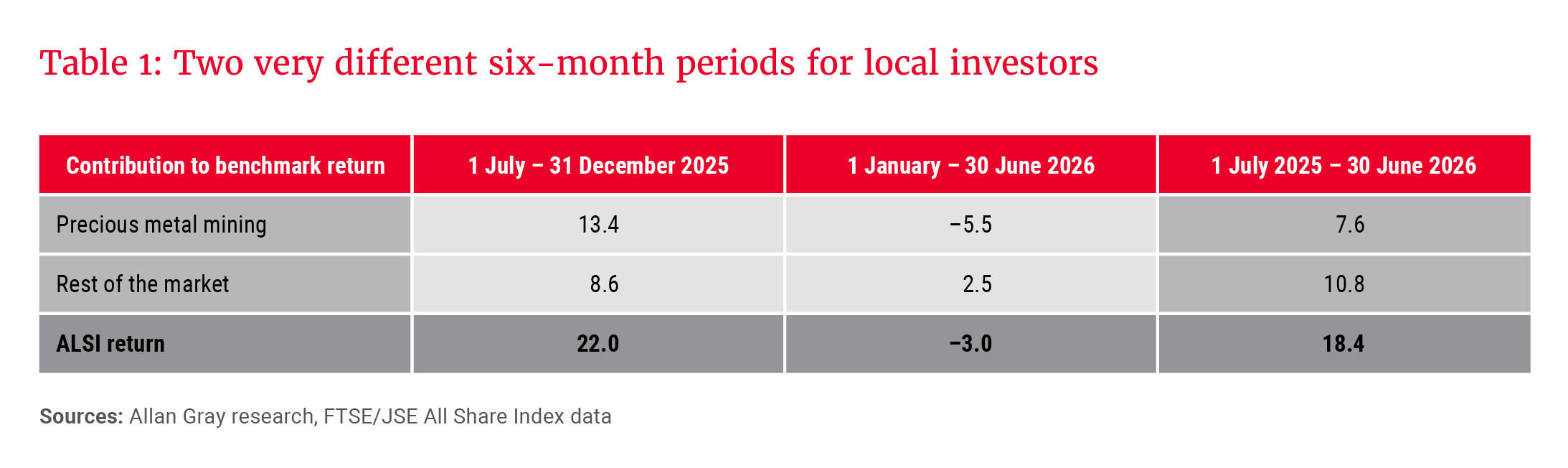
Given the sector’s contribution to market returns in 2025, investors with no exposure would have found it difficult to keep pace with the broader South African market. During the first six months of 2026, the ALSI had a return of -3.0%, and there has been a sharp reversal in the fortunes of precious metal miners. The very sectors that drove most of the market’s gains in late 2025 became a significant drag on returns during the first half of 2026.
We continue to believe that some exposure to precious metals can be useful in client portfolios.
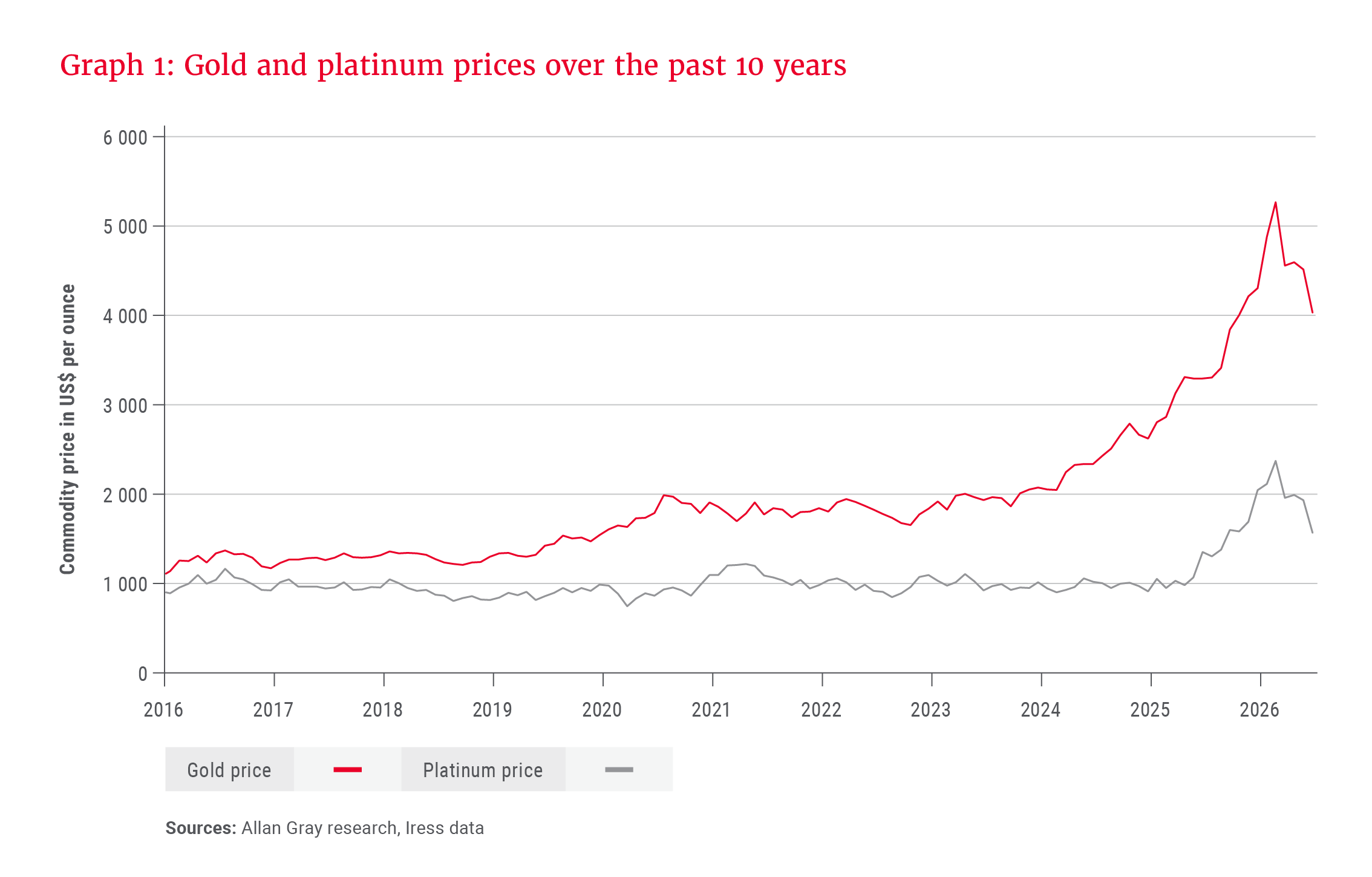
Global uncertainty has made gold more attractive to many investors. Ongoing geopolitical tensions, moves by some countries to become less reliant on global trade, and concerns about the long-term value of currencies, particularly the US dollar, have all played a role. As shown in Graph 1, gold prices have risen strongly, supported by buying from central banks and investors, although some of the recent strength may also reflect short-term speculation.
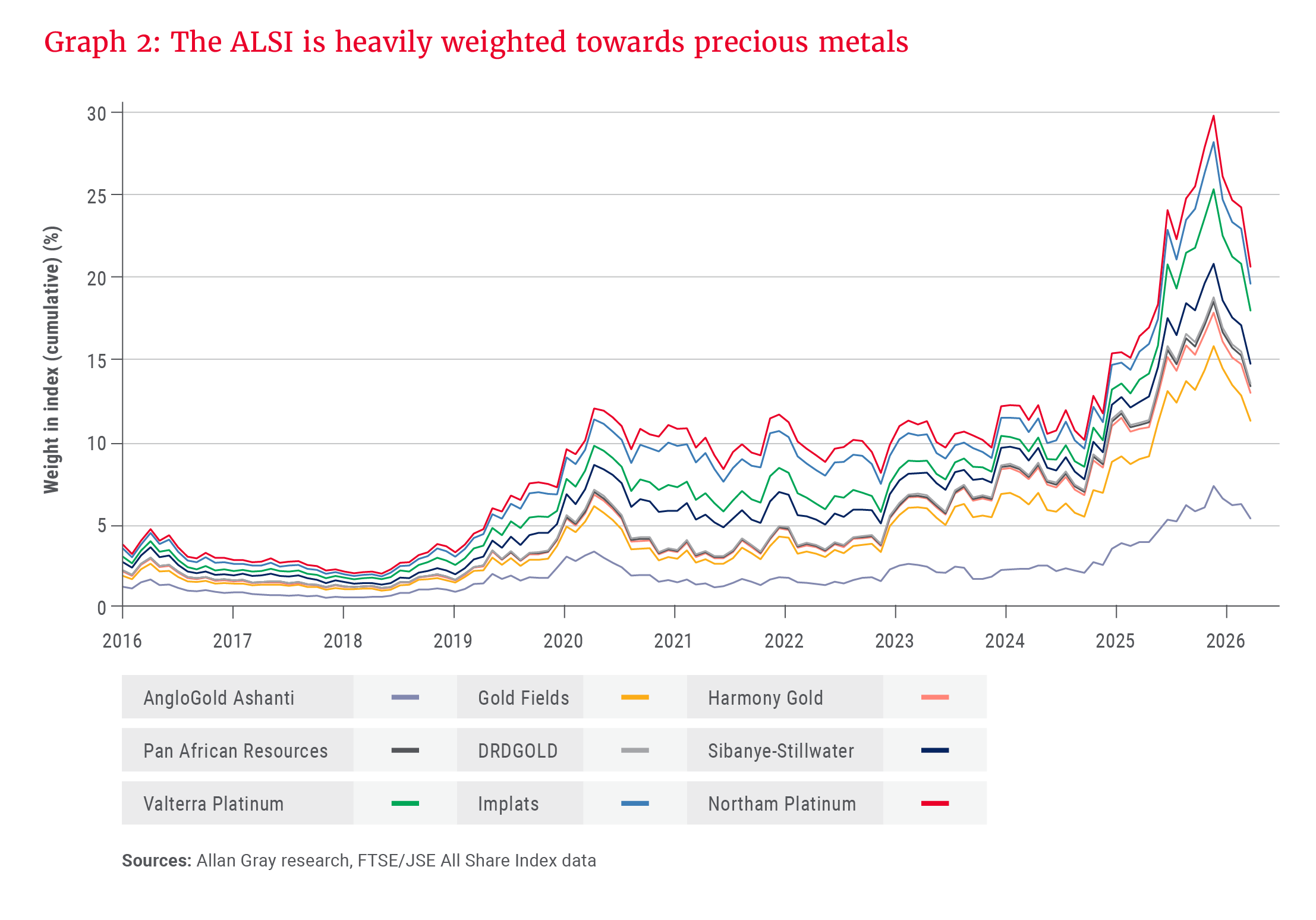
The sharp rise in precious metal prices translated directly into substantially higher market valuations and, in turn, larger index weights for precious metal counters. Among the precious metal miners listed in South Africa, the combined market capitalisation of the nine major companies accounted for less than 5% of the ALSI a decade ago, but approached 30% in February this year, as shown in Graph 2. Unsurprisingly, when a part of the market rallies, investors motivated by fear of missing out raise their exposure to that market segment.
At Allan Gray, the main risk we aim to avoid is the risk of permanent capital loss. Our approach does not begin with the index in mind; we build our portfolios from the bottom up, focusing on intrinsic value and the fundamental risks in every share we own. This means we will often be invested very differently from both the index and our peers. It may also come as a surprise to investors just how different the South African market looks today compared to its own history, as explained in the detailed piece “The ALSI’s evolution in a changing economy” in our Q3 2025 Quarterly Commentary.
Are prices sustainable?
When the share price of a mining company rises because the underlying commodity price has increased, investors need to consider what is already reflected in the current valuation. Higher valuations can be justified if companies are able to grow production or if commodity prices remain sustainably above their cost of production.
We remain attracted to the diversification benefits that precious metals can bring to portfolios, but we size these positions carefully …
We do not know where precious metal prices will trade over the next year, or the next five. Historically, commodities such as gold have often performed well during periods of conflict and uncertainty, reflecting their perceived safe-haven characteristics. However, the relative weakness in gold and platinum prices since March 2026 suggests that earlier price levels may have been elevated already, and investors were paying a substantial safe-haven premium.
A long history of analysing gold and platinum mining businesses
Allan Gray has owned precious metals (through the mining companies as well as physical commodities via ETFs) over multiple periods, and at times we have been overweight relative to the ALSI, as shown in Graph 3. We continue to believe that some exposure to precious metals can be useful in client portfolios. However, we do not believe it is sensible to match the sector’s current index weight. Historically, shareholders in mining companies have not always captured the full benefit of higher commodity prices. Rising profitability at the miners has often been accompanied by cost inflation, increased capital spending and poor capital allocation decisions.
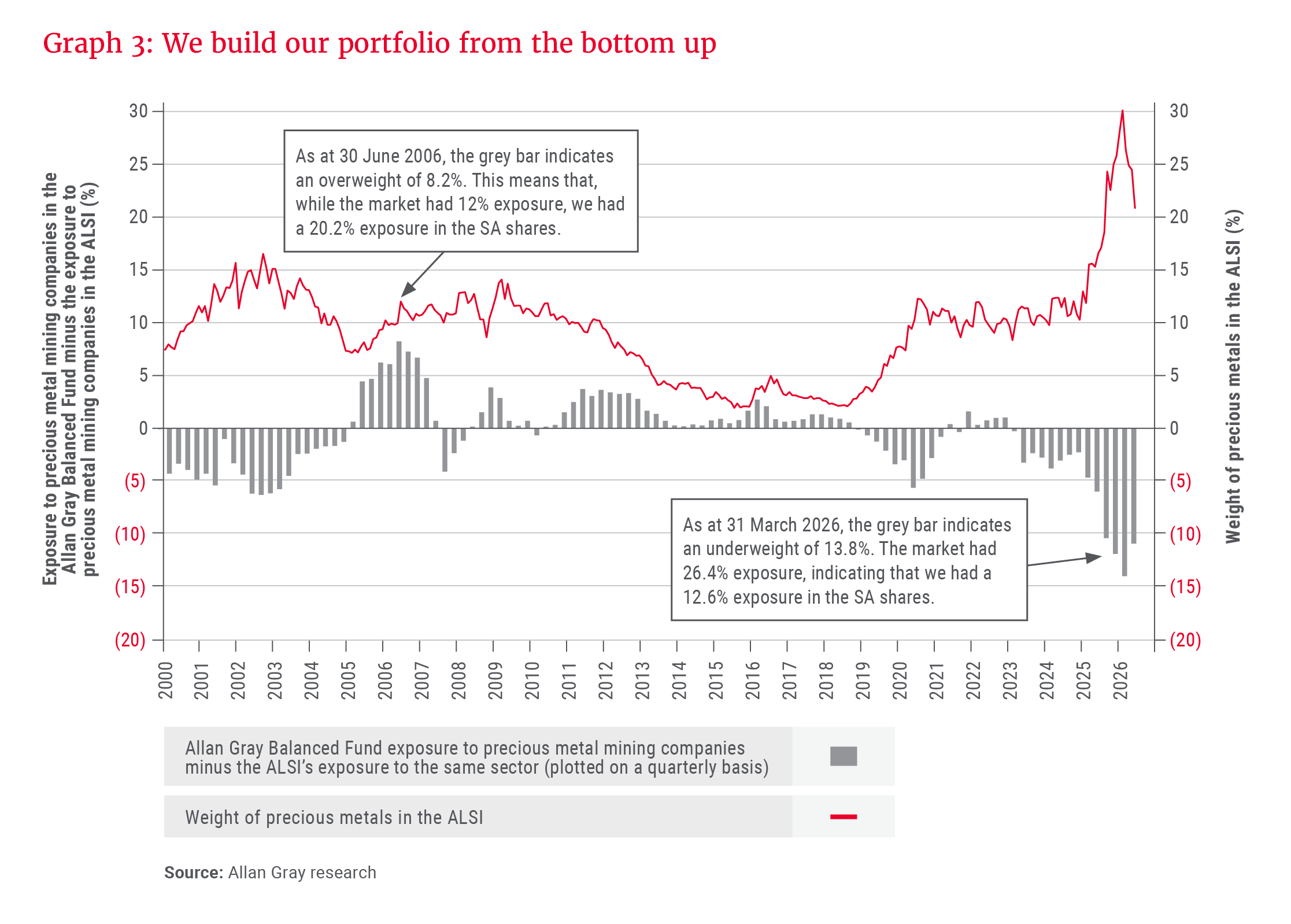
We remain attracted to the diversification benefits that precious metals can bring to portfolios, but we size these positions carefully, taking account of today’s valuations and the risks, which include the cyclical nature of the underlying businesses. At the end of June, precious metal mining companies accounted for 10% of the domestic equities in the Allan Gray Balanced Fund – a reasonable allocation in our view, but well below the current ALSI weight of 21%. We believe that managing risk in today’s market is not about avoiding precious metals altogether, but ensuring that the size of our exposure remains appropriate relative to the opportunities and risks we see.
- 2026 Q2 Comments from the Chief Operating Officer by Mahesh Cooper
- What you own in this crazy world by Duncan Artus
- Developed market government borrowing costs are at a 20-year flashpoint by Thalia Petousis
- Orbis Global Cautious: A disciplined approach to risk and return by Mark Dunley-Owen
- Your retirement, your choices: Making sense of the options by Richard Carter
- Long-term investing in a short-term world by Mthobisi Mthimkhulu
To view our latest Quarterly Commentary or browse previous editions, click here.