
Carefully balancing risk and return has become increasingly important in an investment environment marked by volatility and uncertainty. Mark Dunley-Owen from our offshore partner, Orbis, explains how the Orbis Global Cautious Fund has delivered strong performance, highlighting its valuation-driven stock selection, cautious positioning in bonds, and strategic use of hedging and gold – while staying true to its risk-conscious mandate of preserving and growing capital over the long term.
The Orbis Global Cautious Fund applies a cautious balance between investment returns and risk of loss using a diversified global portfolio. This approach has led to pleasing results, with the Fund outperforming its benchmark and peers, particularly in recent years.
Investors may question how this was achieved and, more importantly, whether the Fund has remained true to its risk-conscious mandate. Put differently, have we increased risk in pursuit of greater returns? The question is particularly relevant because markets have become increasingly volatile.
Our job as stewards of your capital is not to avoid risk altogether, but to take it selectively where we believe we are adequately compensated for doing so.
America and Israel attacked Iran, which responded by closing the Strait of Hormuz, one of the most important global trade waterways. Brent crude oil, the driver of many global prices, almost doubled from January to March, then subsequently fell by nearly a third. SpaceX, which was privately valued at US$400bn a year ago, listed at US$1.8tn, the largest IPO ever, and rose to more than US$2.5tn in the first few days. AI demand skyrocketed, leading to wide-ranging supply tightness and moves that few predicted – the share prices of computer memory firms such as SK Hynix and Sandisk are up several-fold over the past year.
Against this backdrop, it would be fair to question whether we have been leaning into this volatility and increasing risk. Were this true, clients could be concerned about what comes next. No investor is right all the time, and higher risk usually leads to future periods of poor performance, which would be at odds with the Cautious Fund’s mandate to limit the risk of loss over the short to medium term. The portfolio’s approach to balancing risk and return is best explained by looking at what the portfolio is, and isn’t, invested in.
Selective equity exposure
Equities, considered the riskiest asset class in public markets, are a natural risk lever. Equity markets have performed strongly year to date. A well-timed bet, expressed via higher equity exposure or by owning riskier equities, might have been a driver of the Fund’s recent returns. However, as Graph 1 shows, the Fund’s net equity exposure has been near or below 30% in recent years.
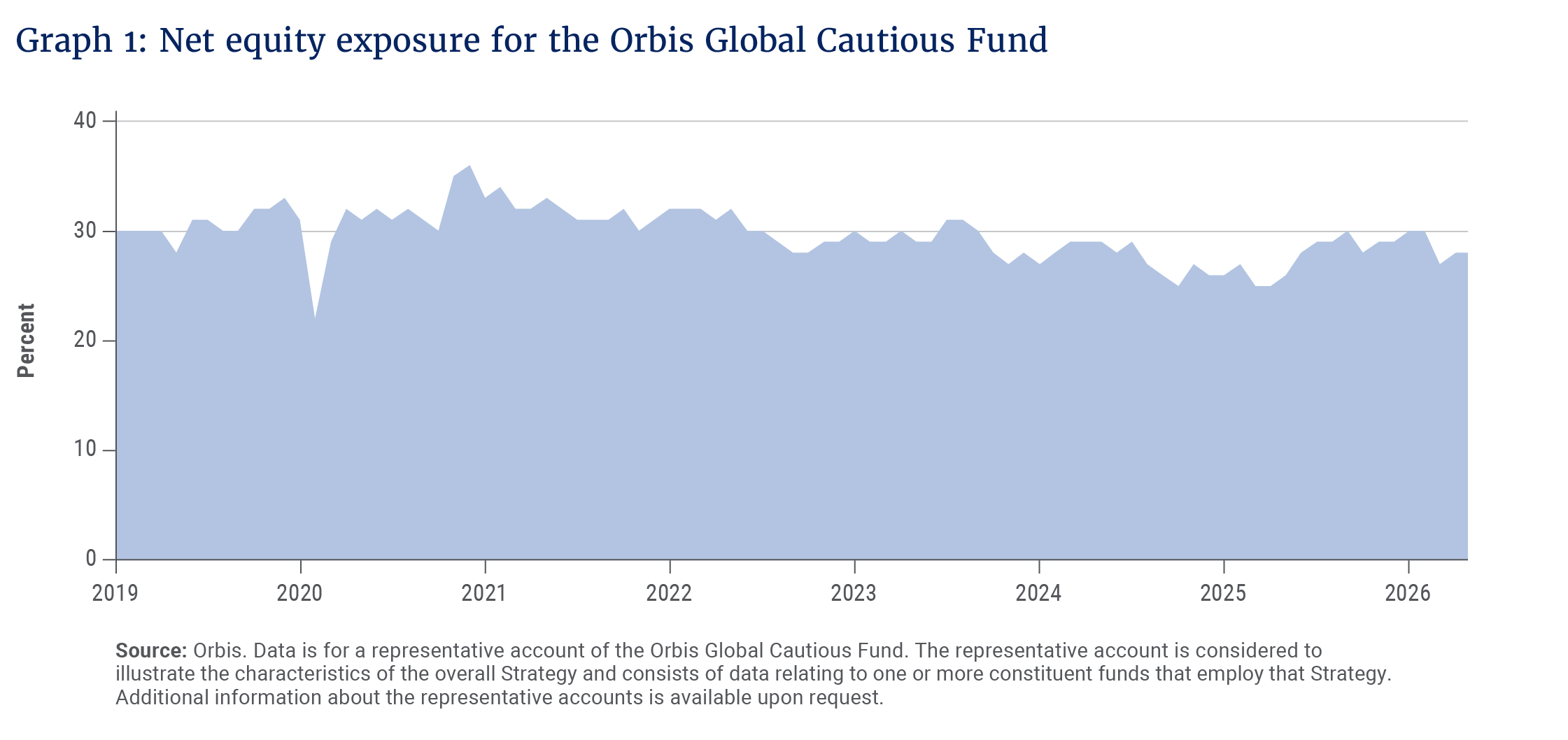
What we own is also important, since equities are not equally risky. The portfolio’s equity holdings have a beta below one and a relatively low correlation to the market, meaning they are less sensitive to broad market swings and behave differently from the index. The equity risk we are taking is largely stock-specific and valuation-driven, not a broad market call.
Our equities have also, since inception, traded at a valuation discount to world stock markets, as shown in Graph 2.
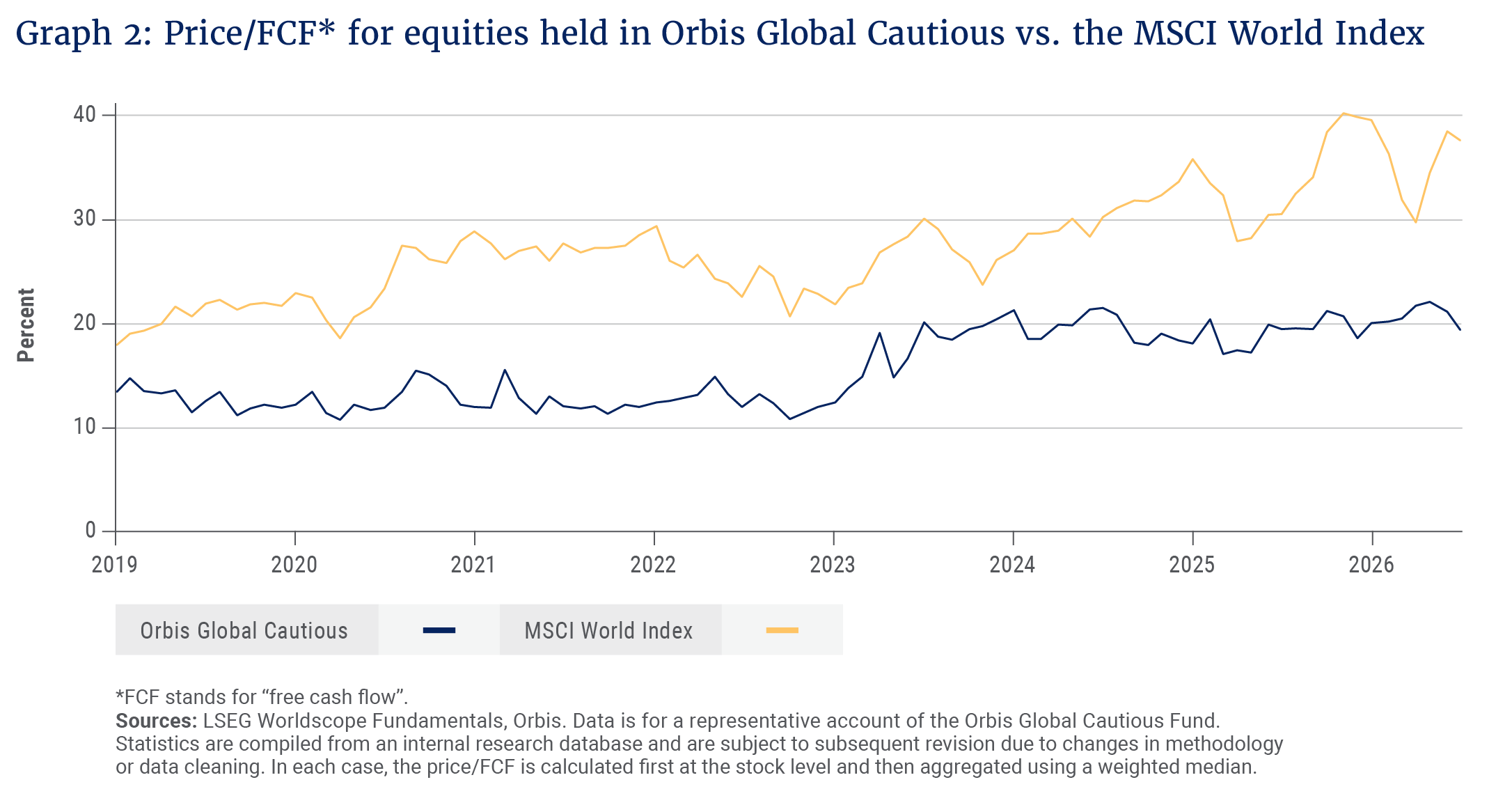
In other words, we are paying less for every dollar of free cash flow our companies generate, suggesting lower expectations for our shares and potentially less downside if sentiment turns. And many of the underlying companies carry modest debt relative to earnings, providing resilience when surprises arrive, as they inevitably do. Taken together, these metrics highlight that the portfolio’s recent performance has been generated without excessive equity risk.
... fixed income is the biggest component and an important driver of returns.
Hedged equity is another tool we use to manage risk. Selling liquid equity index futures allows us to maintain exposure to undervalued equities while hedging out market risk. We maintain the equity alpha potential while removing the market (beta) exposure.
The US is a good example. Despite viewing the broader US market as expensive, through our fundamental, bottom-up research, we have uncovered a select number of attractive individual companies. These are not the names one reads about in the headlines and range from energy-related companies like Kinder Morgan and EQT to movie theatre players like Cinemark and IMAX, and biotech companies such as Alnylam Pharmaceuticals. We own these shares because we believe their value is underappreciated, not because they are in the US. By hedging out some of the US market risk, we maintain what we like (idiosyncratic alpha) while removing some of what we don’t (US market beta).
Strengthening portfolio resilience
While equities may be considered the riskiest asset class in the Fund, fixed income is the biggest component and an important driver of returns. Here, too, the portfolio seeks to limit risk.
We remain cautious on traditional developed market government bonds, notably those of the US, UK, Europe and Japan. The safe-haven status of these bonds reflects past perception rather than today’s fundamentals and, in our view, current prices don’t adequately reflect their rising risk profile.
The developed market bonds we do own are mostly a barbell of inflation-linked and short-duration US sovereign bonds, designed to limit the portfolio’s exposure to inflation. We see inflationary pressures building on both the supply and demand sides of the global economy. On the supply side, the consequences of protectionist policies such as tariffs, re-industrialisation and the Iran war are contributing to higher input costs and overall prices. On the demand side, the substantial AI capital spending is also contributing to inflationary pressures. We expect these dynamics will keep inflation and bond yields elevated and put downward pressure on bond prices. Our short-duration and inflation-protected bonds should perform relatively better in this environment.
The Fund’s other government bond holdings are spread across countries that are ignored or mispriced but, in our view, are being soundly managed. These include Australia, Brazil, Iceland and Norway, all of which offer attractive yields, with the upside of inexpensive currencies.
The Fund’s corporate bond exposure remains modest and focused on idiosyncratic opportunities where we believe the risk-reward is attractive. At the aggregate level, corporate credit spreads remain tight and, in our view, do not adequately compensate investors for the risks they are taking.
The environment we have described ... is precisely the kind in which our approach is designed to add value.
Gold is an appropriate place to round up our discussion. We established the Fund’s gold-related position several years ago in response to rising government debt burdens, persistent fiscal deficits and aggressive monetary policy. Gold was not popular at the time and the price languished until 2024. We viewed it as an important risk mitigator in a cautiously managed fund and were happy to remain patient.
Fast-forward to today, the gold price has appreciated significantly, and the portfolio’s gold exposure has been a material return contributor. In response, we have trimmed the gold allocation and shifted exposure from the metal into selected miners, notably Barrick and Newmont, whose share prices had lagged the rising gold price in 2024 despite improving fundamentals.
Staying true to our cautious mandate
Our job as stewards of your capital is not to avoid risk altogether, but to take it selectively where we believe we are adequately compensated for doing so. We aim to run a low-risk fund, not a no-risk fund. The environment we have described – elevated inflation, expensive conventional safe havens and a market adjusting to a volatile world – is precisely the kind in which this approach is designed to add value. Our Global Cautious Fund seeks to meet the challenge of balancing risk and reward through a portfolio built from the bottom up, security by security, with the aim of preserving and growing your capital over the long term.
- 2026 Q2 Comments from the Chief Operating Officer by Mahesh Cooper
- What you own in this crazy world by Duncan Artus
- Developed market government borrowing costs are at a 20-year flashpoint by Thalia Petousis
- Managing risk in bullish markets by Jeff Tshikhudo
- Your retirement, your choices: Making sense of the options by Richard Carter
- Long-term investing in a short-term world by Mthobisi Mthimkhulu
To view our latest Quarterly Commentary or browse previous editions, click here.