
Developed market bonds are trading near their yield highs, or price lows, last seen 15 to 20 years ago. While inflation is partly to blame, another factor is that many developed market sovereigns are running some of the widest fiscal deficits on record outside crisis periods, including the COVID-19 pandemic and global financial crisis. Thalia Petousis investigates how governments have reached this point, and what fiscal debt traps mean for investors when allocating cash to sovereign fixed income markets.
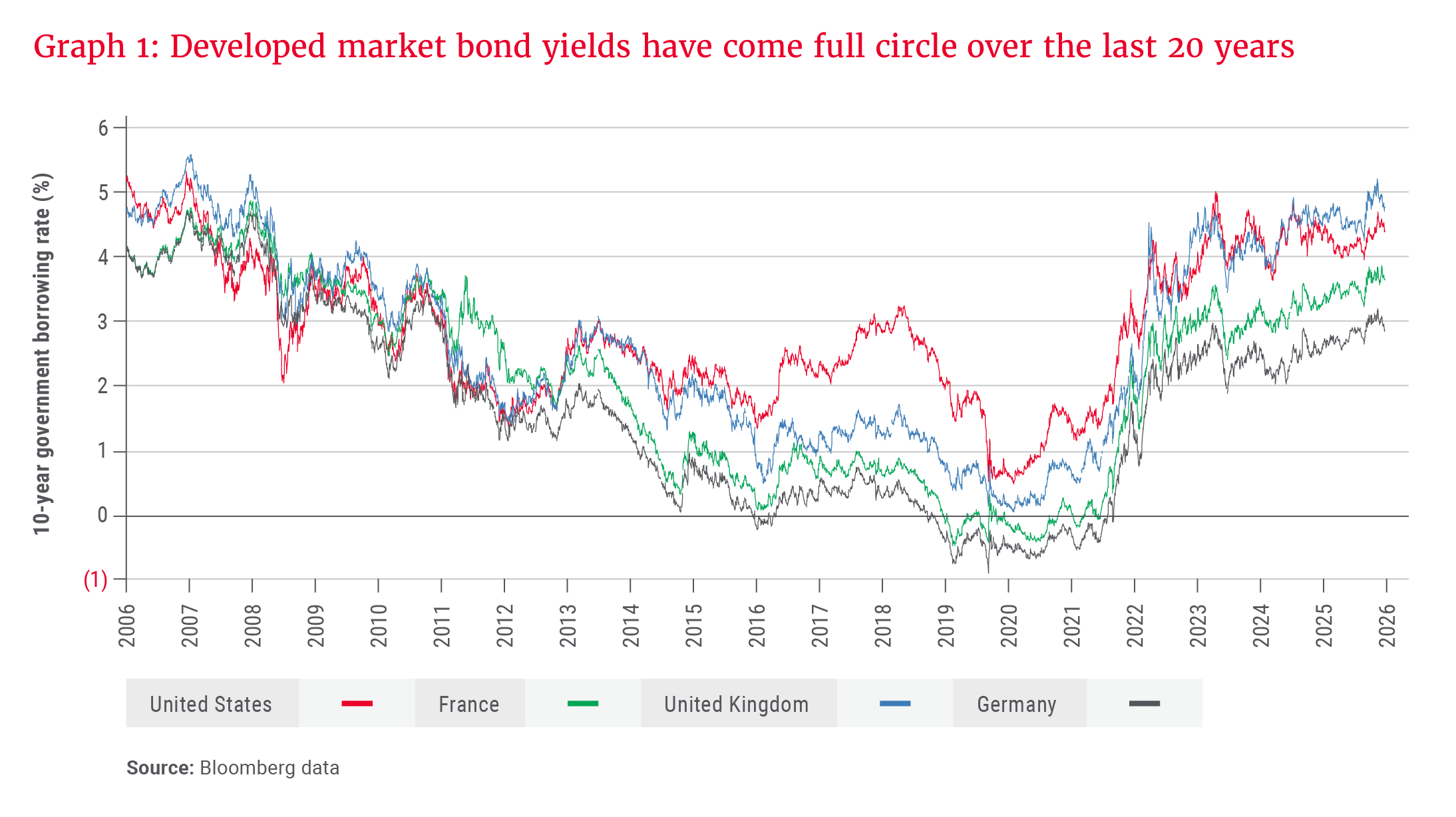
In Western economies, long-term government borrowing costs have been mostly rising over the last four years. The recent sell-off in long-dated US government debt saw 10-year Treasuries trade at a yield as high as 4.66% and 30-year Treasuries trade above a 5% yield. Similarly, as shown in Graph 1, long-dated borrowing costs for the governments of France, Germany and the UK recently reached yields not seen in almost 20 years, reverting to rates last observed in 2007, prior to the global financial crisis (GFC).
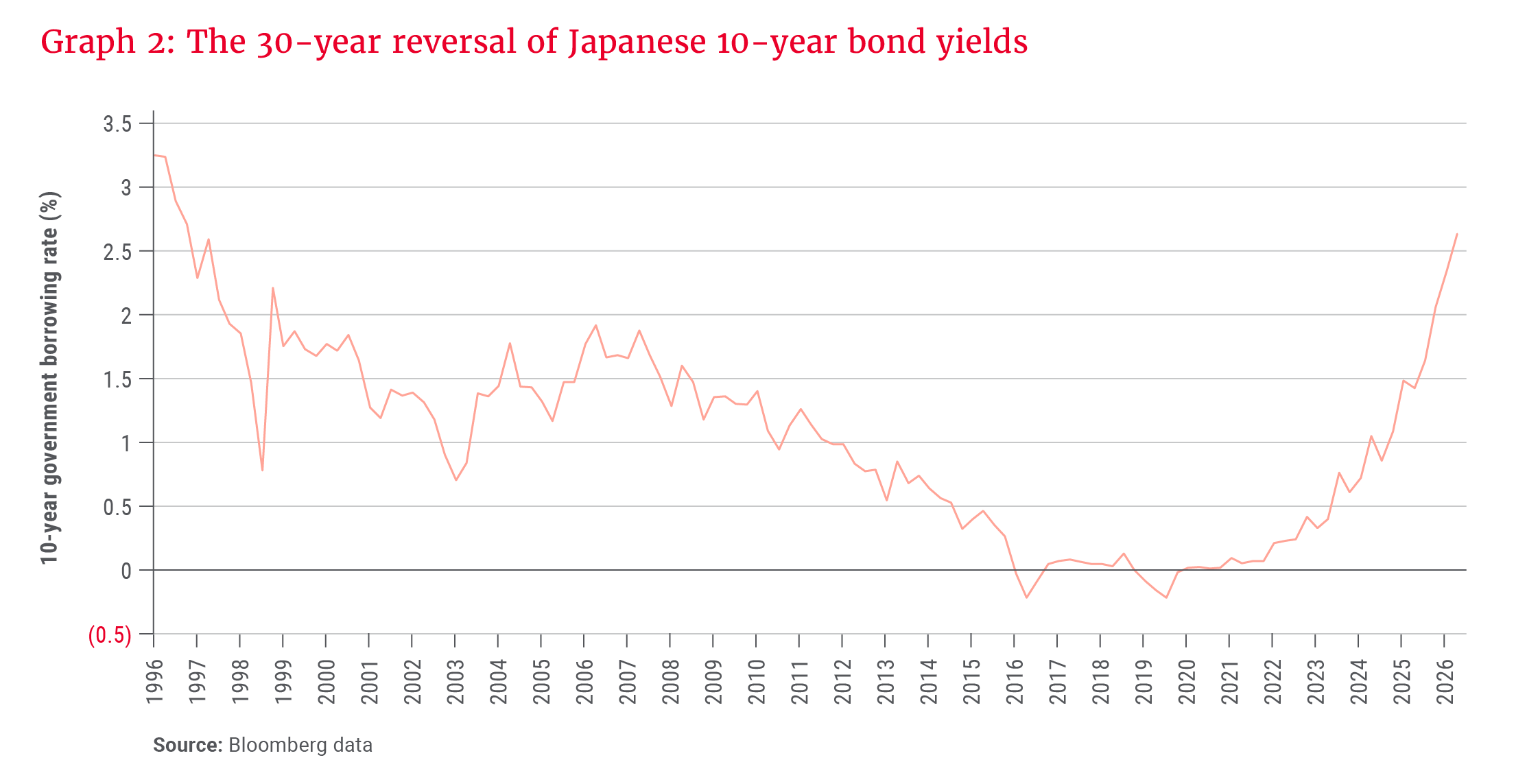
In Japan, the recent rise in government borrowing costs represents an even more profound 30-year reversal, as shown in Graph 2, taking yields back to levels last seen in 1996.
While, on paper, these rates have superficially come full circle over 20 or 30 years, that is where the parallels end. There is an ominous deterioration in the present-day economic backdrop compared to the last time we saw yields at these levels. In 2006, the issue that was plaguing financial markets and which spurred yields higher was a debt-fuelled leveraging up of private sector and banking and consumer balance sheets, which caused the US housing market to experience an unsustainable increase in house price valuations. By contrast, the government’s debt burden when measured as a percentage of gross domestic product (GDP) was reasonably low at the time – representing 60% of GDP in the US, or roughly half the present-day debt load.
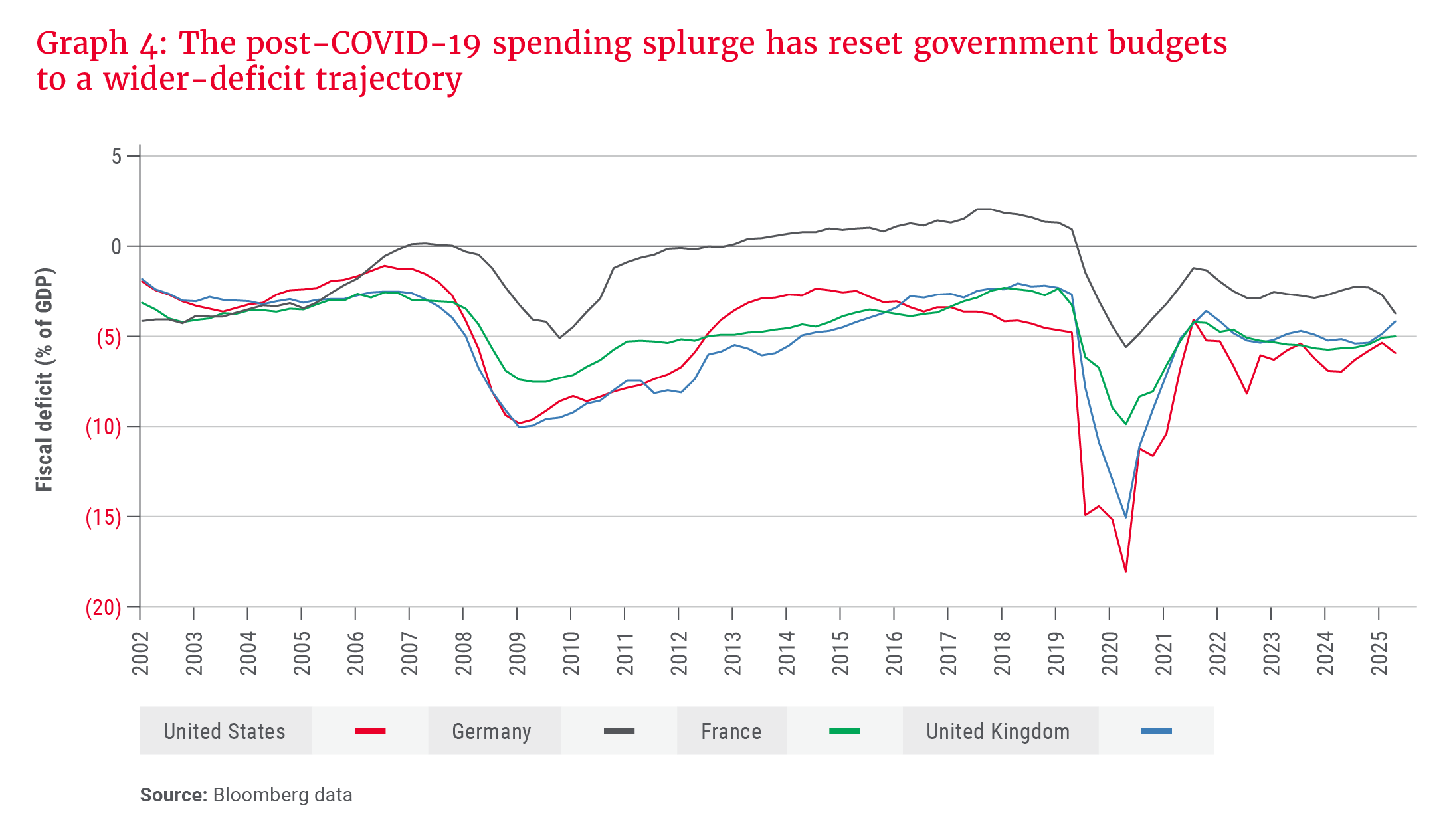
The fiscal deficit, or degree to which governments overspend relative to their tax revenue, was also muted in 2006 to 2007, at roughly -1.5% to -3% of GDP across the US, UK, France and Germany. By contrast, today’s fiscal deficits are almost four times as large in the US, making it near-impossible for gross debt levels to stabilise – with the International Monetary Fund forecasting US debt to rise from 120% to 140% of GDP over the next four years.
… conventional wisdom regarding the behaviour of developed markets versus African and frontier governments is being turned on its head.
It would be incorrect to say that developed market sovereigns had lost control of their long borrowing rates in 2006. In fact, the US and UK 10-year government borrowing costs of 4.7% in late 2006 were lower than their overnight rates of roughly 5%. This means that the market was extending considerable goodwill to the sovereigns.
By contrast, long bond yields of roughly 5% in the UK and US today do not compare as favourably to an overnight rate of 3.7%, and surely reflect a partial loss of investor confidence in sovereign creditworthiness. Current market pricing suggests that there must be a term premium (or additional yield pick-up that is earned by the investor) if one is to extend long-term borrowing to government entities that may enter debt distress over the coming period. By many definitions, the developed market governments under discussion have already entered a so-called debt trap, in which their interest bills compound faster than tax revenue growth, crowding out their ability to meet social welfare and recurrent spending obligations.
How have developed markets reached this point?
As shown in Graph 3, it is clear that the 2008 GFC was a turning point for debt burdens, which initially began to climb as sovereigns engaged in emergency spending to stabilise the financial system and bail out troubled financial institutions. Fiscal spending also ballooned as part of efforts to support consumers through expanded unemployment benefits and welfare programmes.
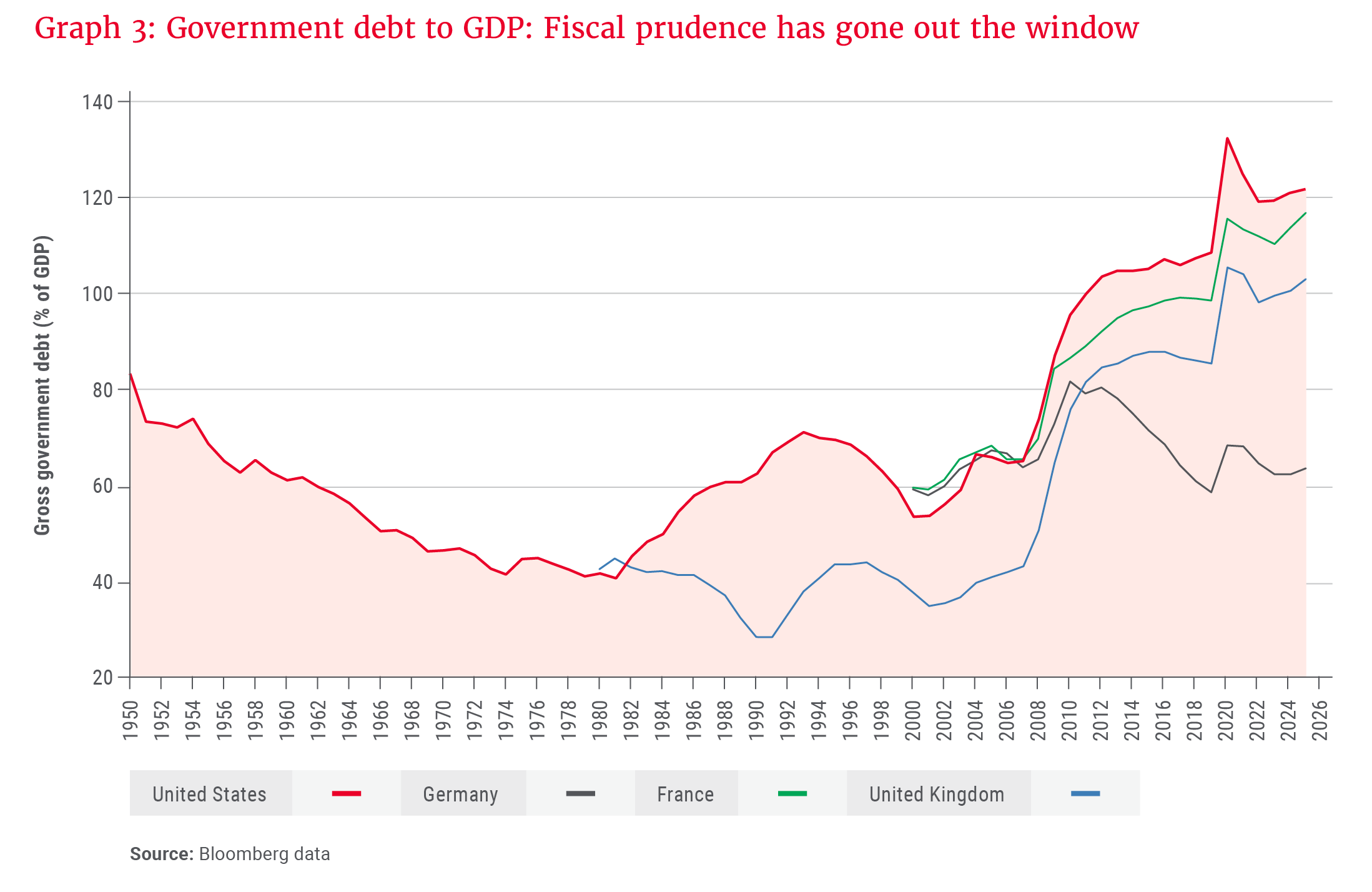
This economic stimulus was not short-lived, and I would argue that, in an effort to limit any form of recession-induced economic pain, the governments under discussion – with the exception of Germany – never stopped overspending. By contrast, Graph 3 also shows us that, despite debt ramping up in the early 1990s due to the cost of the first Iraq war and a mild recession, the US was able to rein in debt during the latter part of the 1990s through tax increases, legislative spending caps, and a large reduction in defence spending. Alarmingly, we have not witnessed the same “reining in” of spending as penance for past excesses since then.
Following the COVID-19 pandemic, governments responded with an even higher degree of overspending than during the global financial crisis …
In Graph 4 below, one can observe that fiscal deficits, or the degree of government overspending measured as a percentage of GDP, ballooned following the GFC. In the US, this represented a permanent step change in higher government spending that was never curtailed. Germany quickly returned to fiscal prudence, but France and the UK took more than a decade to return to pre-GFC deficit levels. Following the COVID-19 pandemic, governments responded with an even higher degree of overspending than during the GFC, and none has yet returned to pre-COVID-19 deficit levels.
Why have fiscal deficits never recovered to pre-COVID and pre-GFC levels?
The politics of spending
The first reason is that the political climate has changed considerably. In the 1990s, President Bill Clinton’s administration was widely admired for its budget deficit reduction efforts and arguable fiscal stewardship. Today, deeper political polarisation and legislative division have made the traditional tools of deficit reduction – tax increases or austerity – akin to political suicide. France, for example, is governed by highly fractious minority coalitions that have paved the way for a revolving door of leaders, with a staggering turnover of six prime ministers in the last three years.
To survive no-confidence votes, prime ministers across developed markets have consistently had to renege on fiscal austerity lest they go the way of the former UK prime minister, Keir Starmer. With the constant threat of being voted out – or, in the US, the risk of losing one’s party majority in the House or Senate – politicians have shown remarkable willingness to cave in to populist demands and refrain from exposing their constituents to painful expenditure cuts.
The rise of the welfare state and an ageing population
Offshore developed market sovereigns have also structurally baked in larger social and entitlement spending over time that now keeps a vast cohort of voters afloat. The UK spends more than one-third of its national budget on social welfare and state pensions.
With the constant threat of being voted out … politicians have shown remarkable willingness to cave in to populist demands …
An ageing population makes the recent rise in welfare payouts increasingly unsustainable and creates a systemic structural deficit. Approximately 55% of all social security expenditure goes directly to pensioners. This is problematic: When the modern UK welfare state was originally designed, there were roughly six working-age adults to support every one pensioner over 65; today, roughly three working-age adults carry that burden. In Germany, this problem has underscored a recent proposal to lift the retirement age to 67. Disability claims related to poor mental and physical health in the UK are also reaching record highs, and approximately one in 10 working-age adults in Great Britain now receive support.
Defence spending is sacrosanct in a geopolitically unstable world
Slashing defence budgets to curtail deficits is increasingly becoming a political impossibility due to heightened global conflicts. In fact, the recent rise in Germany’s fiscal deficit (shown in Graph 3) is the beginning of a multi-year plan to bypass the so-called “debt brake” and gear the country towards rearmament. Cumulatively, Germany is projected to spend well over EUR500bn on defence and a separate EUR500bn on infrastructure over the next decade, or a combined 25% of GDP. While Germany arguably has more fiscal headroom to accommodate such spending than its sovereign peers, this increase in military expense is prevalent across the entire Western world.
Debt compounds quickly
More debt breeds more debt, especially when the interest service bill begins to compound at the high interest rates that have accompanied recent inflationary and geopolitical shocks. In many of the countries under discussion, interest expense is eating a rising share of tax revenue over time and crowding out other spending initiatives.
What do fiscal difficulties and even debt traps mean for investors?
As shown in Graph 5, an investor allocating US$100 to various offshore developed market bonds in 2009 would have experienced dismal returns over the subsequent 17 years. Germany’s sovereign debt markets have at least allowed investors to just about preserve the value of their capital in real US dollar terms (after adjusting for US inflation over the period).
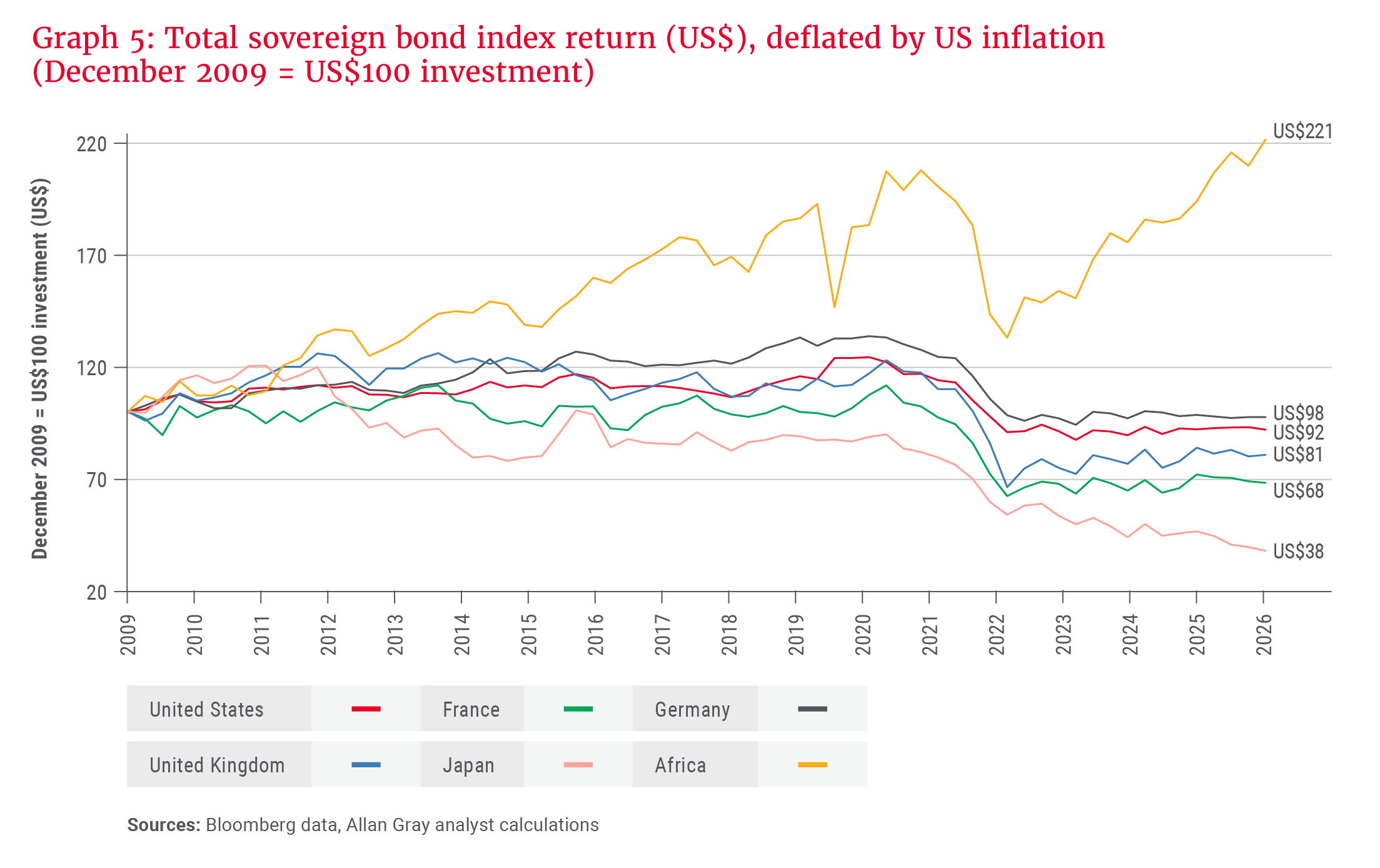
In US Treasury markets, an investor would have lost 7% worth of inflation-adjusted value over the aforementioned period. For sovereign debt market investors in the UK, France and Japan, the outcome would have been abysmal – with investors in Japanese debt markets losing more than 60% of their capital in US dollar and inflation-adjusted terms.
The most surprising takeaway of Graph 5 may be the excellent returns investors in African sovereign debt markets would have enjoyed over this time – including investors in the Allan Gray Africa Bond Fund (see the latest factsheet). How can this be?
Firstly, African debt markets are almost always priced for failure with exceptionally high funding yields that compensate investors for the risk of ruin, default, illiquidity, high volatility and intra-year capital drawdowns. Due to fear of these markets, there are substantial premiums to be earned for investors who can stomach the volatility, pick the winners from the losers, and find cheap entry points where the opportunities present themselves. These are markets that we like to invest in.
Additionally, there are rational fundamental reasons for the more recent outperformance of African debt markets, which have broken away from stagnating or negative developed market returns and delivered strong positive returns over the last four years. As shown in Graph 6, the median sub-Saharan African fiscal deficit is -3.2% of GDP at present – well below the deficits of Germany, the UK, France and the US.
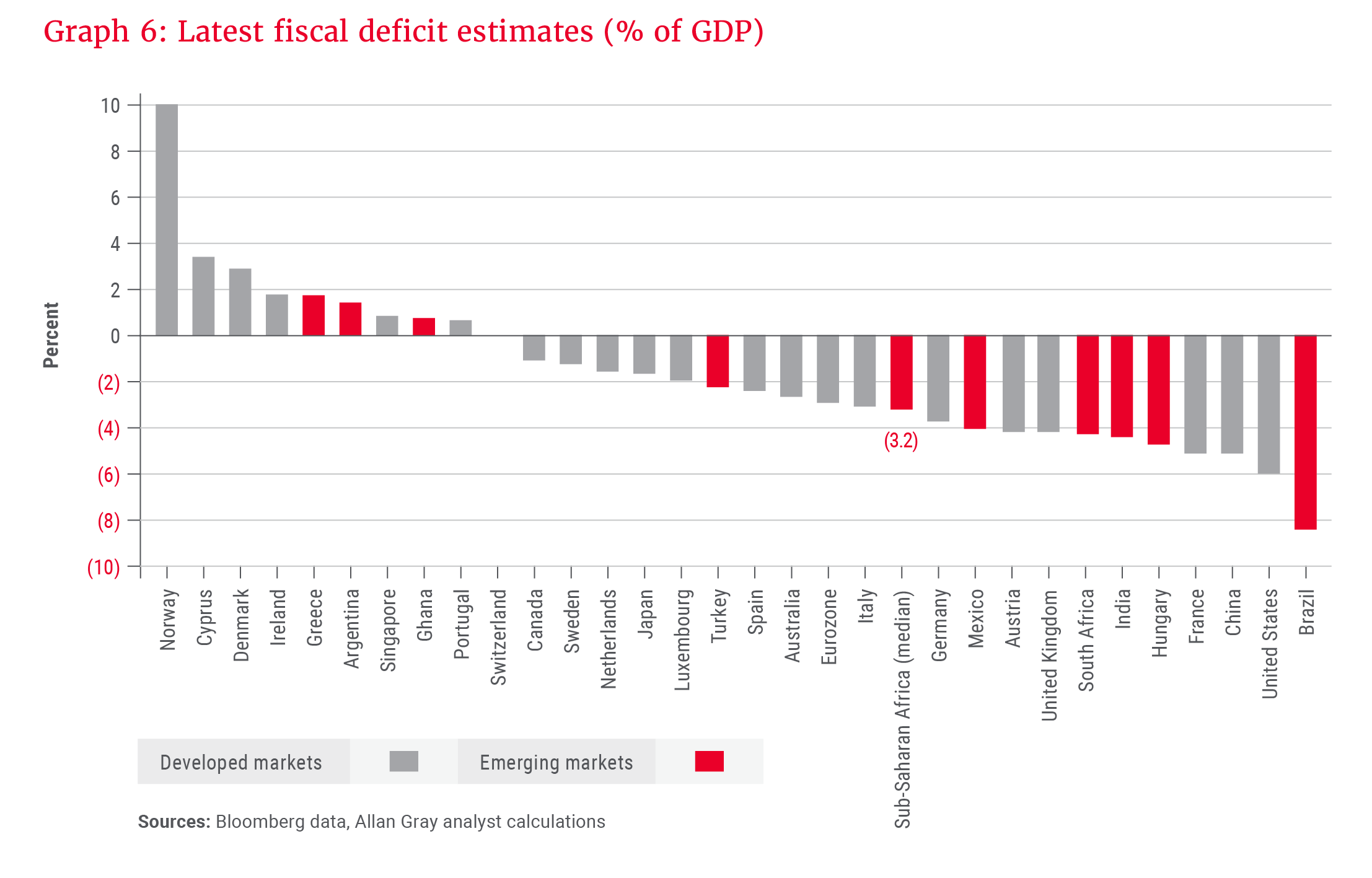
Furthermore, after stripping out the interest bill, there are many African sovereigns – including South Africa – that are running primary budget surpluses. This means that their in-year primary spending is lower than revenues, allowing them to put that surplus cash aside to pay down some of the interest bill and potentially reduce their overall debt burden.
After facing the harsh realities of investors who have been unwilling to refinance African country debt, as well as forced austerity, hard-currency shortages and currency depreciation, these African governments are prioritising fiscal discipline and learning to live within their means more than they have in decades past. By contrast, developed market governments are behaving as we would expect so-called junk-rated sovereigns to conduct themselves: caving in to fiscal largesse and populist demands for unbridled spending.
In short, conventional wisdom regarding the behaviour of developed markets versus African and frontier governments is being turned on its head. A painful learning period for developed market governments may still be to come.
- 2026 Q2 Comments from the Chief Operating Officer by Mahesh Cooper
- What you own in this crazy world by Duncan Artus
- Managing risk in bullish markets by Jeff Tshikhudo
- Orbis Global Cautious: A disciplined approach to risk and return by Mark Dunley-Owen
- Your retirement, your choices: Making sense of the options by Richard Carter
- Long-term investing in a short-term world by Mthobisi Mthimkhulu
To view our latest Quarterly Commentary or browse previous editions, click here.