
South Africa’s investment shortfall does not stem from a lack of domestic capital, but from weak public-sector governance, limited competitive advantages and too few viable opportunities. Forcing retirement funds and other institutional investors to allocate more assets locally would constrain diversification, increase risk and ultimately weaken the savings pool on which financial stability depends. According to Sandy McGregor and Matthew Patterson, a better policy response is to strengthen public sector institutions and create conditions that allow private capital to invest where sound opportunities exist.
In February 2022, the South African Reserve Bank confirmed that the offshore investment limits for all investment and product providers had been set at 45%. This meant that the foreign investment limit for retirement funds, as stated in Regulation 28 of the Pension Funds Act, was also increased to 45%. Since then, the decision has been occasionally questioned, notably by Minister of Finance Enoch Godongwana, who said in February 2024 that it was a grave mistake. While he may have had second thoughts about his statement, others have said that South African savings institutions should be forced to invest a greater proportion of their assets locally to promote domestic growth. However, there are strong reasons to believe that these concerns are misplaced and that investors in unit trusts, the beneficiaries of pension funds and insurance policies, and the economy as a whole, have benefited from the increased foreign allowance.
The preservation of the value of the institutional savings pool
In March 2026, South African institutional savings, being the aggregate of unit trusts, life insurers, public sector pension funds, and private pension funds, stood at roughly R15.7tn. This asset is equivalent to approximately 186% of South Africa’s gross domestic product (GDP). Direct foreign investments accounted for 31.6% or R4 949bn of this asset. Prior to the increase of the foreign allowance to 45% in 2022 (from 30% outside of Africa plus an additional 10% in Africa ex-SA previously), the proportion in foreign assets was 28.6%. This accumulated pool of savings is of critical importance to the stability of the South African economy. It underpins the pension system and is the most important source of funding for the fiscal deficit.
South African equity market lacks diversification opportunities
A key investment principle is that a portfolio should have a diversified spread of assets to optimally manage risk. The South African equity market cannot, on its own, provide this breadth. Although the composition of the Johannesburg Stock Exchange (JSE) has changed considerably over time, it has remained concentrated and structurally different from the world market. Today, it is heavily weighted towards mining and financial companies, while several important global industries are poorly represented or absent. Table 1 shows the market value of companies listed in South Africa, as at 31 August 2026, while Graph 1 shows how different the composition of the South African equity market is from that of the world market.
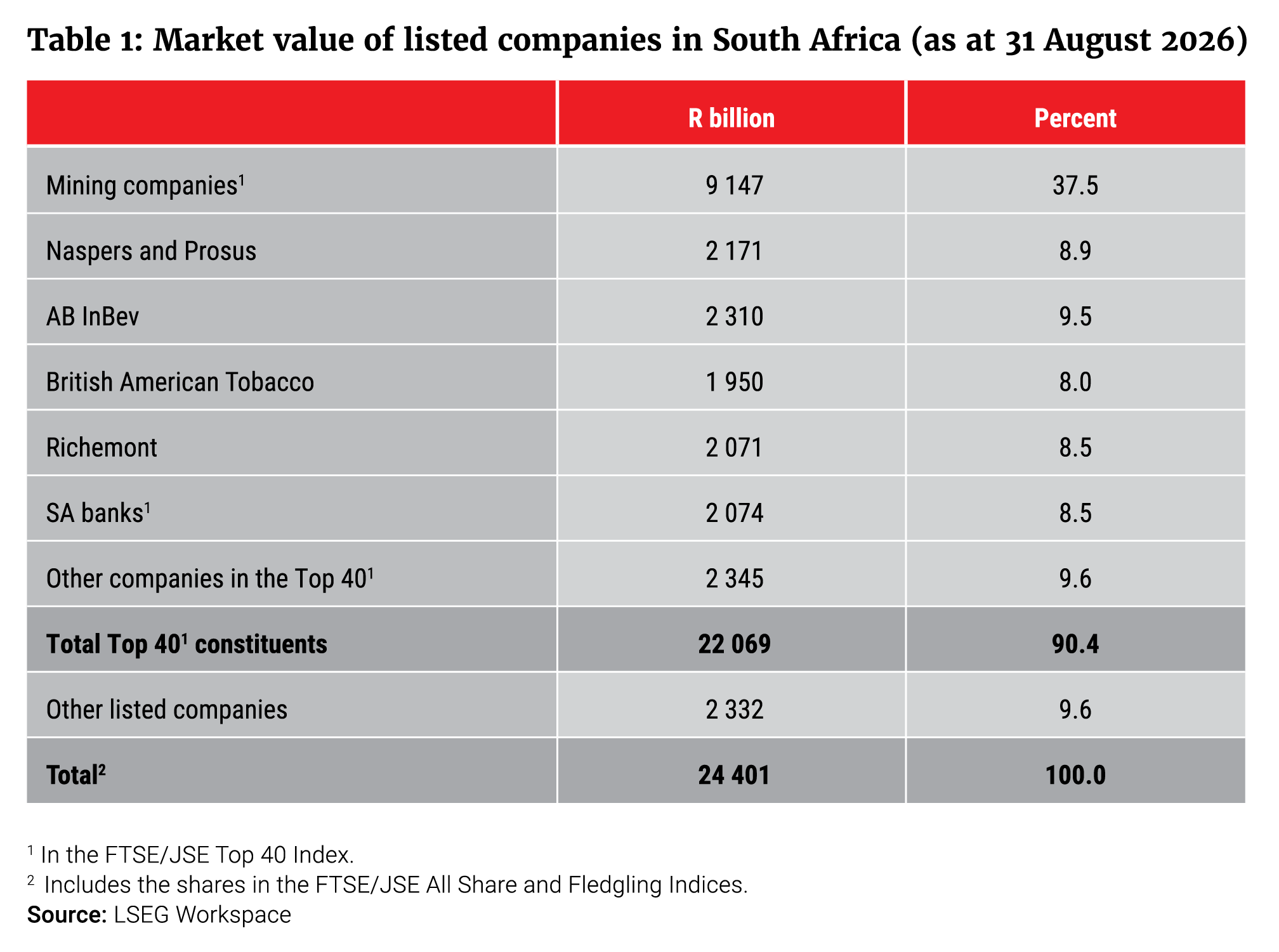
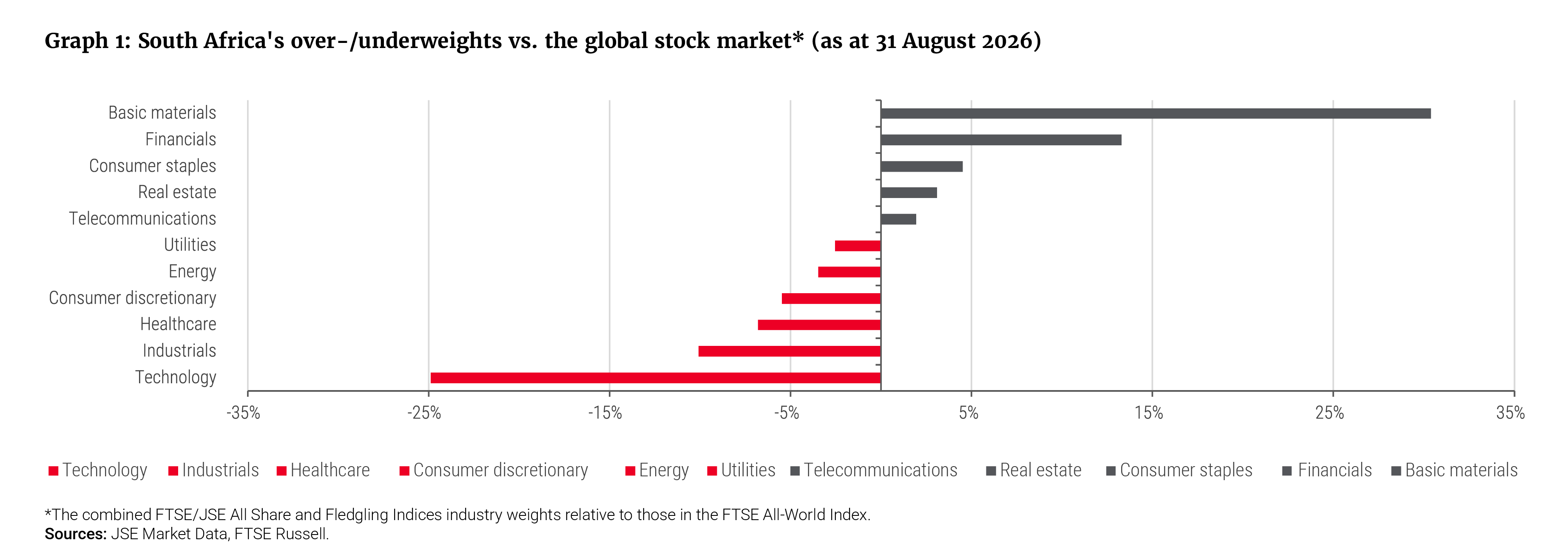
In August 2026, Basic materials and Financials accounted for 62.6% of the local market’s capitalisation, compared with 18.9% of the FTSE All-World Index. Consequently, the fortunes of local investors depend on commodity prices, domestic credit conditions and the profitability of the financial sector. At the same time, the local market has relatively little exposure to many of the industries driving the world economy. Technology is underrepresented by almost 25 percentage points, while Industrials and Healthcare are underrepresented by 10.1 and 6.8 percentage points respectively. These sectors have attracted considerable global investment in recent years, but they are barely represented in South Africa. Utilities are absent. Apart from Sasol, there are no oil shares. A portfolio confined to the local market therefore excludes large parts of the global investment opportunity set. Any reduction in the freedom of domestic investors to diversify their portfolios beyond what is locally listed will reduce their ability to optimally manage their savings.
South Africa now accounts for only about 0.4% of the FTSE All-World Index. The 45% offshore allowance enables investors to create portfolios which are better aligned to the global opportunity set. Its purpose is not to express a negative view of South Africa. It is to avoid making the retirement savings of South Africans dependent on a market in which two sectors account for almost two-thirds of value and several important global industries are barely represented. The offshore allowance therefore plays an important role in preserving the value of the savings pool.
The cost of restricting the offshore allowance
Reduced diversification would expose the savings pool to greater risk, which in the long term reduces returns. Poor investment returns erode households’ capacity to spend and reduce the pool of domestic capital required to finance government deficits. Financial stability promotes economic growth. South Africa enjoys such financial stability because it has a large savings pool. Policy should be directed at sustaining this important asset.
Any reduction in the freedom of domestic investors to diversify their portfolios beyond what is locally listed will reduce their ability to optimally manage their savings.
It is possible to estimate the cost of historically applicable foreign allowances on the size of the savings pool by formulating counterfactuals (hypothetical scenarios) to show the impact of a larger foreign allowance, during a period when foreign assets outperformed domestic assets. Graph 2 shows the results under various hypothetical alternatives, which should be regarded as upper limits rather than probable outcomes.
Counterfactual 1 assumes that a 45% allowance was applied from 2011, and that institutions constituting the savings pool each used the same proportion of that allowance which they applied to the actual limit in March 2015. For example, an institution which used two-thirds of its allowed offshore capacity would have used two-thirds of 45%. It is assumed that institutions would gradually rebalance their portfolios towards the target foreign allocations applicable under the 45% counterfactual regime by March 2015. On this basis, the total savings pool would have reached an estimated R17.5tn by the end of 2025, rather than actual R15.8tn. The domestic component would have been R10.6tn rather than R11.3tn. In this scenario, at no point does the foreign allocation reach the 45% limit. It peaks at less than 42%. The resulting allocations are also broadly consistent with those which the institutions themselves have chosen since the limit was increased in 2022.
Counterfactual 2 assumes that investors maintained the same percentage margin below the greater limit as they did when actual limits applied. For example, an investor that was eight percentage points below the old limit would remain eight points below the new 45% limit, giving it a foreign allocation of 37% by March 2015. Under these conditions the savings pool would have increased to R18.5tn in 2025, compared with R17.5tn under Counterfactual 1. The allocation to domestic assets would have decreased by an estimated R0.6tn for a total gain of R2.7tn. At its peak, the aggregate foreign allocation would have subsequently reached, but not exceeded, the 45% ceiling.
In Counterfactual 3, it is assumed that all institutions increased their foreign allocation to the full 45% by March 2015. In this case, the savings pool would have reached R19.4tn in 2025, 23% more than the actual outcome, with domestic assets just R0.1tn less than the actual outcome. Given the relative outperformance of foreign assets, there would have been a continuing repatriation of funds to comply with the 45% limit, with the consequence that the domestic asset pool would have only declined marginally.
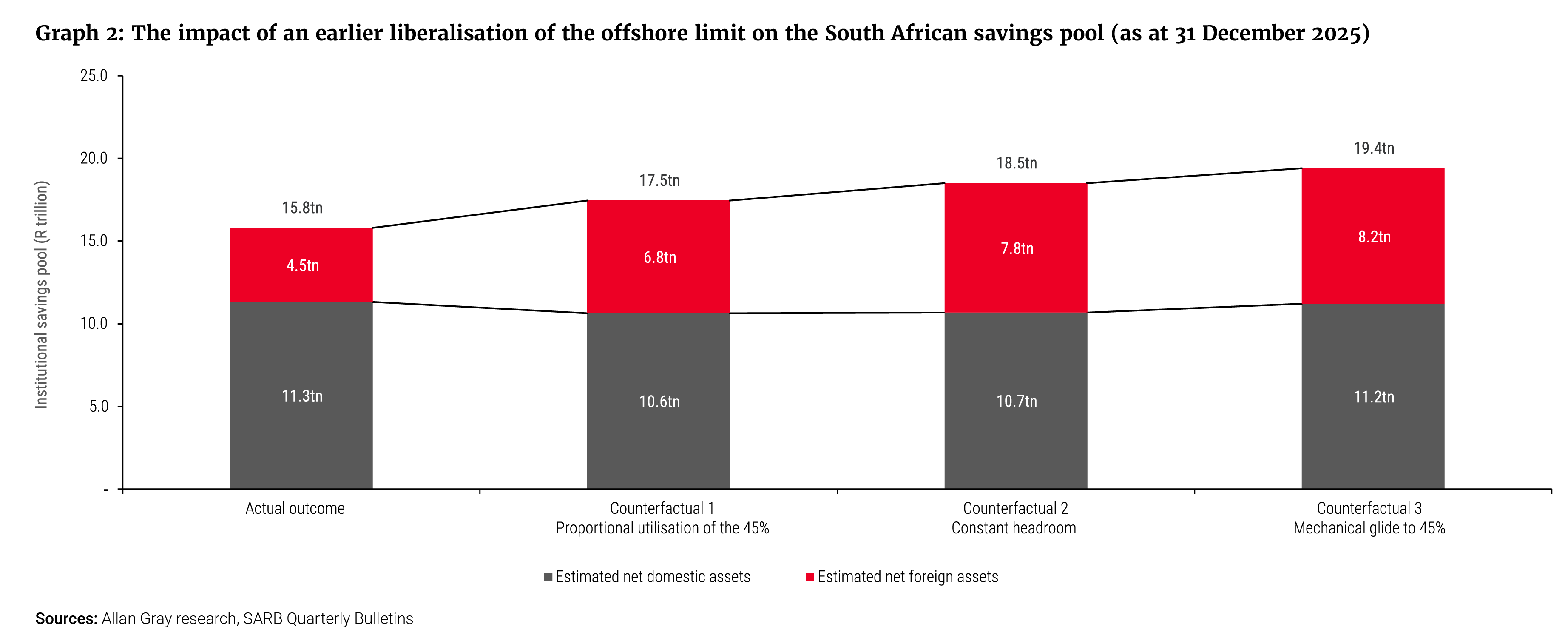
In each case there would indeed have been less money invested domestically, but the total savings pool would have been much larger. In Counterfactual 1, domestic assets would have been R0.7tn lower, while the pool would have been R1.7tn larger. For every rand which was not invested at home, the savings pool would have increased by approximately R2.40.
A reduction in Regulation 28 limits would be a flawed policy choice which would merely make South African investors poorer.
This is the price of restricting the offshore allowance in a period when foreign assets outperform local assets and investors take advantage of this. It may marginally increase the amount invested domestically but would do so at the cost of a reduction in the savings pool. Given the higher interest rates prevailing in South Africa, a smaller domestic asset pool would not necessarily reduce the balance held in local bonds and cash. In that case local equity holdings would be reduced. A reduction in Regulation 28 limits would be a flawed policy choice which would merely make South African investors poorer.
South Africa’s investment drought
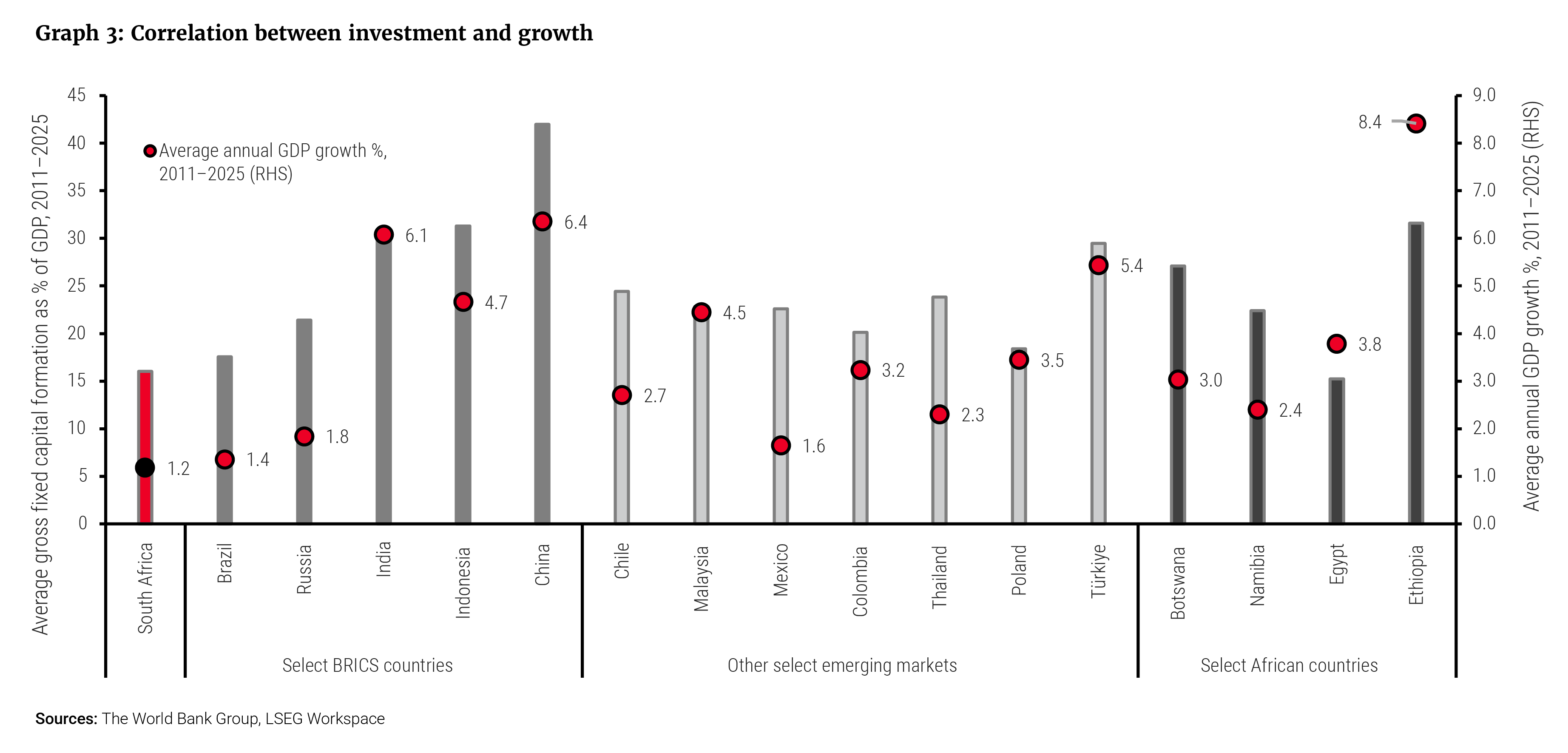
It has become commonplace to blame South Africa’s economic stagnation on underinvestment. As shown in Graph 3, over the past 15 years, fixed investment in South Africa has averaged about 16% of GDP, compared with approximately 42% in China and more than 20% in most emerging markets. The countries which invested the most tended to grow the fastest. However, this underinvestment is not the consequence of a lack of money. Where there is a credible business model, the required investment is made. There has been notable success in rolling out solar and wind power. The telecommunications industry has invested heavily to upgrade its networks. Banks have invested in a modern digital financial system. The mining industry continues to invest where it finds opportunities. The growth in agricultural production and exports is a remarkable success story, entirely due to the entrepreneurial initiative of private sector farmers. There has been substantial investment in the Western Cape’s tourism potential.
The common theme is that this was all done by the private sector responding to opportunity. The shortage is not of money. It is of projects which offer an acceptable prospective return. The South African corporate sector is generally well capitalised and, when it requires funding, has access to a well-functioning capital market. It can afford to invest.
Over the past 25 years, the infrastructure owned and operated by the public sector has been decimated by a combination of incompetence and corruption. While Operation Vulindlela has started to resurrect broken institutions such as Eskom and Transnet, this has been an exercise in fixing what was broken. The causes of this institutional failure persist throughout the state sector. Local government performance varies considerably across the country, with many municipalities outside the Western Cape facing serious challenges. The major impediment to mobilising private capital to grow public sector investment remains. Without drastic reform of the governance of state institutions, private sector investment will not be forthcoming. Coercion to force such investment would be a stealth tax on investors to promote a misallocation of resources, which would result in slower economic growth.
Private business invests where it believes there is an opportunity. It seeks a market. South Africa’s competitive advantages have been eroded in recent years by the rise of Asia, notably China, as the manufacturing superpower. While there will always be niche opportunities, notably in trade with Africa, our competitive advantages are now largely found in the mining, agriculture and tourism sectors. Cheap electricity used to be an important competitive advantage but with the collapse of Eskom this has been lost and will be impossible to resurrect. The absence of competitive advantages is the biggest impediment to South African economic growth. One of the reasons the government’s economic initiatives so often fail is that they focus on industries such as steel, in which South Africa can no longer compete in international markets. Probably the best example of an underexploited competitive advantage lies in tourism, where the private sector would readily finance growth, provided the state supplies a crime-free environment, roads and water.
Changing Regulation 28 will end in tears
The idea that Regulation 28 can be used to promote economic goals is a good example of a solution looking for a problem. The low level of investment in South Africa is due to factors unrelated to the availability of money. The equity market provides a parallel warning. Restricting foreign investment would not create technology, healthcare or industrial companies on the JSE; it would merely require investors to hold more of a concentrated market. Rational projects will be financed without complex risk-sharing schemes. If public sector governance issues are fixed, investment will flow naturally into projects to improve services to households. Investors will always hold some bonds and cash to diversify their portfolios. A larger asset pool increases the amount available for investing in bonds.
Given the shortage of viable investment opportunities, coercion imposing investment obligations on institutions subject to Regulation 28 would encourage investment in marginally economic and irrational ventures, which would not otherwise proceed. This misallocation of resources would impose a cost on the economy as a whole, the outcome of which would be reduced economic growth and living standards. Financial oppression of investors, forcing them to invest in such projects, will always end in tears.