
Japan’s market rise has been led by large-cap value and AI-related shares, leaving many high-quality mid-cap growth companies behind. Using an example from the Orbis Japan Equity Fund, Kanako Sakai, from our offshore partner, Orbis, illustrates why attractive valuations are creating opportunities for patient investors.
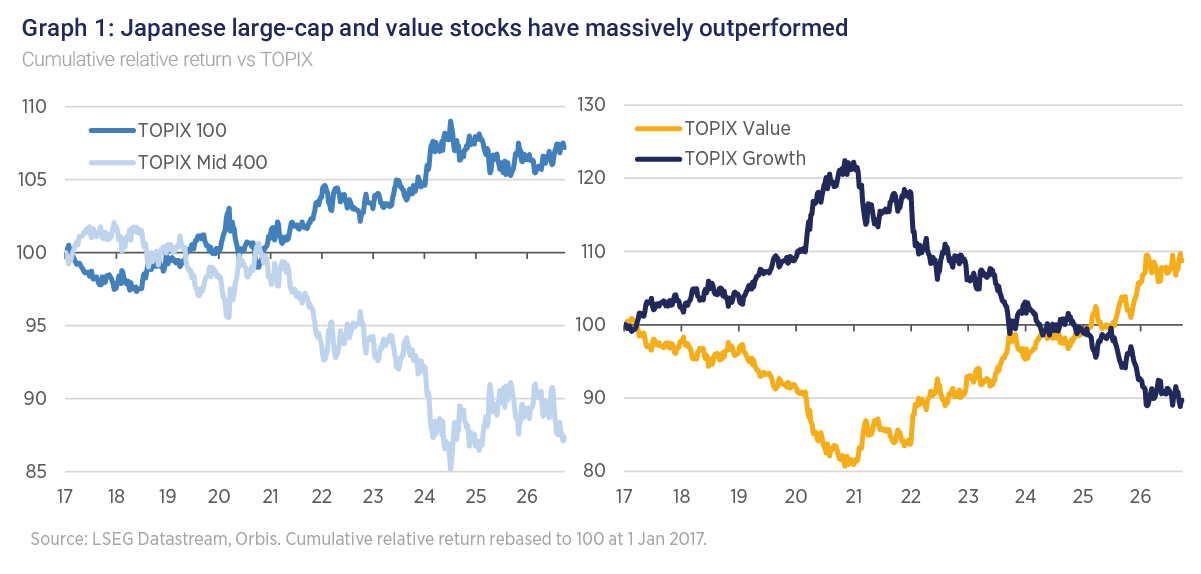
The Japanese stock market has continued its meteoric rise this year, primarily powered by its large-cap ‘value’ names and the many picks-and-shovels companies benefitting from the AI capex boom. Zooming out, the longer-term performance of the TOPIX has been remarkable. The index has now compounded at 15% per annum over the past ten years, with many of what were historically Japan’s stodgiest companies (financials, trading houses, and industrial conglomerates) leading the way, as shown in Graph 1 below. So much for a moribund stockmarket!
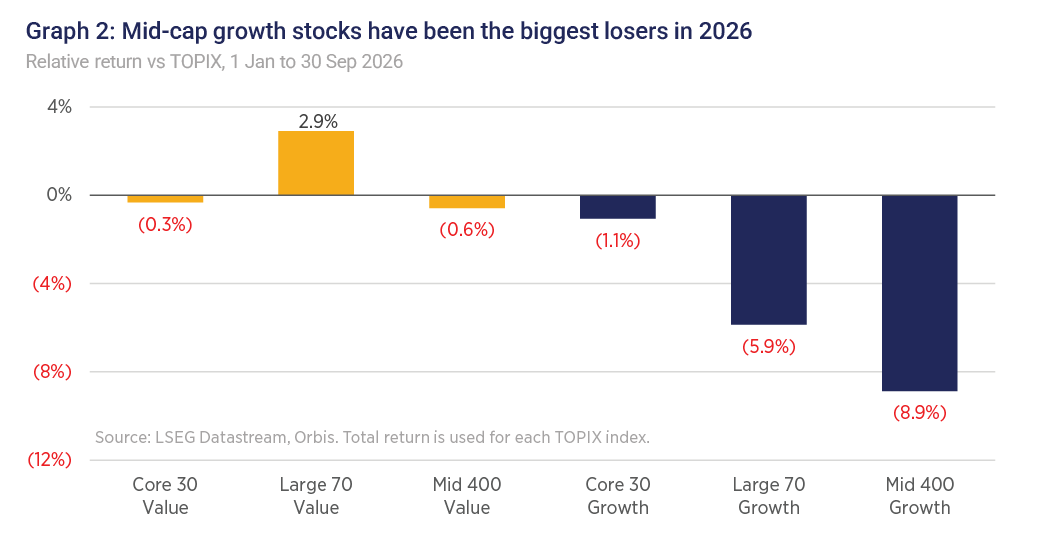
More remarkable still is that many of Japan’s better-run companies – those with many of the characteristics we favour – such as a high return on invested capital, long-term secular growth, and founder-led management, have been left behind. As shown in Graph 2 below, we have found an unusual number of opportunities among Japan’s mid-cap and ‘growth’ names, two of the worst performing areas in the TOPIX over the past decade, despite many of these companies having continued to compound their sales and profits at a stellar rate.
Take Visional, for example, now close to a 5% position in the Orbis Japan Equity Fund. The company operates BizReach, Japan’s largest direct recruitment platform, which connects employers and headhunters with high-income professionals. Think LinkedIn, but without the social networking and with an unusual Japanese twist – all CVs are posted anonymously, with candidates not identified without their consent.
Founder Soichiro Minami, who still owns around a third of the company, launched the BizReach platform in 2009 after spotting an opportunity to invigorate Japan’s sclerotic employment market. Having spent part of his childhood in Canada and studied in the US, Minami brought an unusual cross-cultural perspective. His exposure to the more open US labour market – where professionals actively managed their careers and employers could access talent more directly – helped him recognise the structural limitations of Japan’s established recruitment model.
Japan’s historically opaque recruitment market meant that professionals could not easily discover the opportunities available to them, while employers had limited direct access to candidates and depended heavily on recruitment agencies.
Importantly, Minami did not simply transplant an American platform model but built one adapted to local preferences. BizReach allowed employers and headhunters to approach candidates directly, but candidates only revealed their names with consent – a highly unusual model in Japan at the time. Screened membership created exclusivity and trust, while anonymous profiles and employer-blocking features reduced the risks associated with appearing on a recruitment platform.
Employer-initiated scouting also suited professionals who were open to an attractive opportunity but reluctant to identify publicly as active jobseekers. Meanwhile, retaining headhunters on the platform accommodated Japanese companies’ preference for trusted intermediaries.
This localisation helps explain BizReach’s success where global professional networks such as LinkedIn have historically been less effective. BizReach built a credible pool of active and otherwise hard-to-reach professionals, while giving employers broader access to talent usually at a lower cost than traditional executive-search firms.
As the first mover in its space, and following years of aggressive advertising, BizReach has built a dominant market position, with the strongest brand in the segment and the largest candidate database. Sales growth has been strong, compounding by over 25% p.a. since its public listing in 2021. Despite being the leader in its field, the company accounts for less than 1% of Japan’s ¥10 trillion recruitment market, suggesting there is still ample room to grow.
Notwithstanding this stellar growth, Visional’s shares have lagged the TOPIX by more than 40 percentage points over the past year, perhaps in part due to fears of AI disruption.
The AI bear case sounds compelling at first glance – a meaningful displacement of white-collar jobs by AI will shrink the number of job openings, reducing the need for BizReach’s services, while AI agents will displace the role of headhunters. Defending against all of this will demand heavy investment, compressing margins along the way.
In our view, the market’s concerns are overstated. AI is more likely to disrupt routine and lower-skilled work, while demand for senior, higher-value roles in which BizReach specialises should prove more resilient. The risk of AI agents aggregating candidate data is also less acute than perhaps feared, given that candidate profiles are anonymised, leaving little worth scraping and no reliable way to match individuals across sources. Nor do we expect AI agents to displace headhunters quickly – that preference for trusted intermediaries is deeply held, and our research suggests very few Japanese employers are giving serious thought to entrusting senior hiring to AI or building proprietary tools internally.
In our view, Visional looks far better placed to benefit from AI than to be displaced by it. Visional has already built AI functionality into its BizReach platform, from automated drafting of CVs and job descriptions to job-posting scoring. These features should deepen reliance on BizReach and reinforce already strong network effects. Moreover, its proprietary database of Japanese candidates is an asset that global competitors do not possess and models trained on it are likely to suit the domestic market better than those built primarily on Western, English-language data.
BizReach’s competitive position should also allow it to benefit from other structural tailwinds – a shifting culture around lifetime employment, rising inflation and wage demands, and a shrinking working-age population.
When BizReach launched, the concept of ‘direct recruiting’ was virtually non-existent in Japan. For most of the post-war era there had been little need for it. Under shūshin koyō, or lifetime employment, a graduate who joined a large company expected to stay and moving between employers was frowned upon. But that culture is changing. Companies are cutting their intake of graduates and hiring mid-career professionals instead, while young professionals are changing jobs for higher pay. Despite this, the average Japanese worker changes employer just three times over a working lifetime, compared with ten times for the average US worker, suggesting this shift has meaningful room to run.
Demographics are pushing in the same direction. The working-age population is down roughly 15% from its 1995 peak, but despite the labour participation rate rising, job openings still outnumber applicants. With wages rising after decades of stagnation, employers are competing for experienced staff in a way they have not had to before.
Growth at an attractive price
While the setup looks attractive for Visional to continue its remarkable success, our decision to own the shares ultimately rests on the price we pay. On a headline basis, Visional trades at 18 times this year’s earnings – close to its lowest valuation since listing in 2021. But headline multiples do not tell the full story.
Visional also holds cash amounting to more than 20% of its market capitalisation, and several ‘incubation’ businesses that, while loss-making in aggregate, are still at an early stage and show promise of becoming valuable under the direction of Minami. If we strip away the cash on the balance sheet and exclude the ‘incubation’ businesses, we are able to buy the core BizReach business at just 13 times this year’s earnings. Certainly, to us, an attractive valuation for a company that has compounded profits at a 25% annual rate over the last seven years.
But this exercise assigns essentially zero value to Visional’s promising other businesses. We are paying nothing for businesses like HRMOS – the company’s suite of human-resource management tools, which, while still lossmaking, has grown sales at a compound annual rate of over 45% since 2019. Other fast-growing ventures in areas such as cybersecurity and logistics are also showing promise.
Visional is just one of the many high-quality growth names we have identified in Japan’s mid-cap space. We have built positions in the likes of GMO Payment Gateway, an electronic payments provider; OBIC, an enterprise software company; Otsuka Corporation, a provider of total office solutions; and MonotaRO, an e-commerce distributor of maintenance, repair, and operations products. All are names that we have long admired but have only recently been able to acquire at favourable valuations. Some, like Visional, appear to be under a cloud due to fears of AI disruption, while others may have just been left behind as the market focuses its attention elsewhere. We cannot say when the cloud may lift, or sentiment might shift, but as is often the case, our pivot into this underappreciated area of the market looks to have been early, and our short-term relative underperformance has been painful. We expect patience to be rewarded.