
Successfully identifying businesses with enduring competitive advantages requires a disciplined, valuation-driven approach. While many consumer businesses face challenges such as shifting preferences, intense competition and uncertain growth prospects, some high-quality companies remain overlooked and underappreciated despite their strong fundamentals. Mark Dunley-Owen from our offshore partner, Orbis, highlights how Anta Sports, Nintendo and Greggs exhibit the characteristics of proven long-term winners and explains why their attractive valuations present compelling investment opportunities for patient investors.
Investing requires having a view of the future. This is hard, especially for businesses that operate in unpredictable industries. Consumer businesses fit this category because tastes change often and technology has made it easier for others to copy a product or find the next big thing. As a result, many consumer businesses have struggled with slower growth, lower margins and tougher competition. Share prices have fallen, with some of them near historical lows. They look cheap, which excites value investors like us. We have looked at but rejected many of them, usually because the business appears structurally damaged or is poorly managed. That is how our process works. As bottom-up investors, we reject many more ideas than we buy.
We have, however, found some consumer businesses that trade at compelling prices. These are not the ones whose share prices have fallen the most, but rather businesses that remind us of proven winners while not being priced as such.
We are particularly excited when we can own companies that remind us of the greats, but are not priced as such. Anta Sports, Nintendo and Greggs fit that mould.
A proven winner is a company that has compounded profits and value for decades. The sporting analogy is a GOAT – the “Greatest of All Time”. Sporting GOATs are often disputed. Is it Novak Djokovic or Roger Federer or Rafael Nadal in tennis? Some cases are clearer. Mikaela Shiffrin won 110 Alpine Ski World Cup races and is the only skier to have won in all six of the sport’s disciplines. Kelly Slater won 11 world surfing titles and was both the youngest champion, at 20, and the oldest, at 39. What distinguishes the GOATs is the ability to maintain an edge and execute at the highest level, repeatedly, over long time periods. The same is true in business. Company GOATs such as Apple, Berkshire Hathaway and Costco are rare but excellent investments and have created enormous wealth for their shareholders.
While obvious in hindsight, few investors have the foresight to buy these companies early and the patience to hold them for decades. The lesson, and focus of this commentary, is to find companies that share qualities with the GOATs but are not yet appreciated as such. In essence, we try to buy great businesses at ordinary prices.
Anta Sports vs. Fast Retailing
Clothing is among the hardest businesses to predict. Few clothing businesses compound value over decades, and the industry is littered with once-popular companies that later disappointed. Gap was a leading business in the 1990s, but its shares have gone nowhere for two decades and remain below their 2000 peak. Nike is the seminal sportswear company, but its total return has lagged the MSCI World Index by 85% over the last five years. Even Lululemon, a recent darling known for its yoga-inspired activewear, is struggling to stay relevant.
Fast Retailing is a notable exception – its share price is up nearly 20 times in 20 years. It owns Uniqlo, the Japanese brand that has grown from a single store in 1984 to a global chain. Uniqlo sells clothes that put function and price ahead of fashion. They are designed for everyday life, appeal to a wide range of people, and are constantly being made better. Fast Retailing’s founder, Tadashi Yanai, remains its president and a large shareholder. He believes that “Without a soul, a company is nothing”, a philosophy that defines Uniqlo. Employees carry pocket cards with his founding principles, such as “Put customers first”, “Give back to society” and “Disrupt yourself before others do”.
Fast Retailing is an exceptional business, but the market recognises that, so its shares trade at a punchy 39 times next year’s expected earnings. The company can stay exceptional and still be a poor investment from today’s starting price.
We own a business that reminds us of Uniqlo but is priced more like Gap. Anta Sports is a Chinese company with a portfolio of sportswear brands. It is often compared to Nike, but its co-founder, Ding Shizhong, famously said, “We don’t want to be the Nike of China, but the Anta of the world.”
Like Uniqlo, Anta’s own brand sells affordable, well-made basics. Its broader portfolio includes brands like Fila, Descente and Kolon Sport, which it operates in China through a mix of ownership and partnership arrangements. These are more specialised, but all offer high quality at attractive prices. Anta is also the largest shareholder in Amer Sports, which has revitalised the Arc’teryx brand, transitioning its strong technical roots towards luxury outdoor wear. Never ones to rest on their laurels, Anta recently agreed to buy a 29% stake in Puma with the goal of repeating their past success of turning around brands in China.
… we expect Anta to successfully navigate this cycle, as it has earlier ones. Earnings should continue to compound …
Anta and Fast Retailing share many similarities. Both grew out of small family businesses. Both founding families remain involved and invested alongside outside shareholders. Both put function and price ahead of fashion. Both spend consistently on innovation while also controlling costs. Both have long records of steady growth, industry-leading profit margins and strong cash generation.
Financially, Anta appears to us the better business of the two. It has grown revenue faster over the last decade, earns a higher operating profit margin, and turns more of its reported profit into actual cash.
As shown in Graph 1, despite its superior fundamentals, Anta trades at a significant discount to Fast Retailing – 11 times next year’s expected earnings versus 39 times. Why would two similar businesses with similar strengths trade at such different multiples? In our view, this is mostly because Anta is Chinese. Consumer spending in China is in a cyclical downturn after a housing bubble, and geopolitical tension has further dented household wealth and confidence.
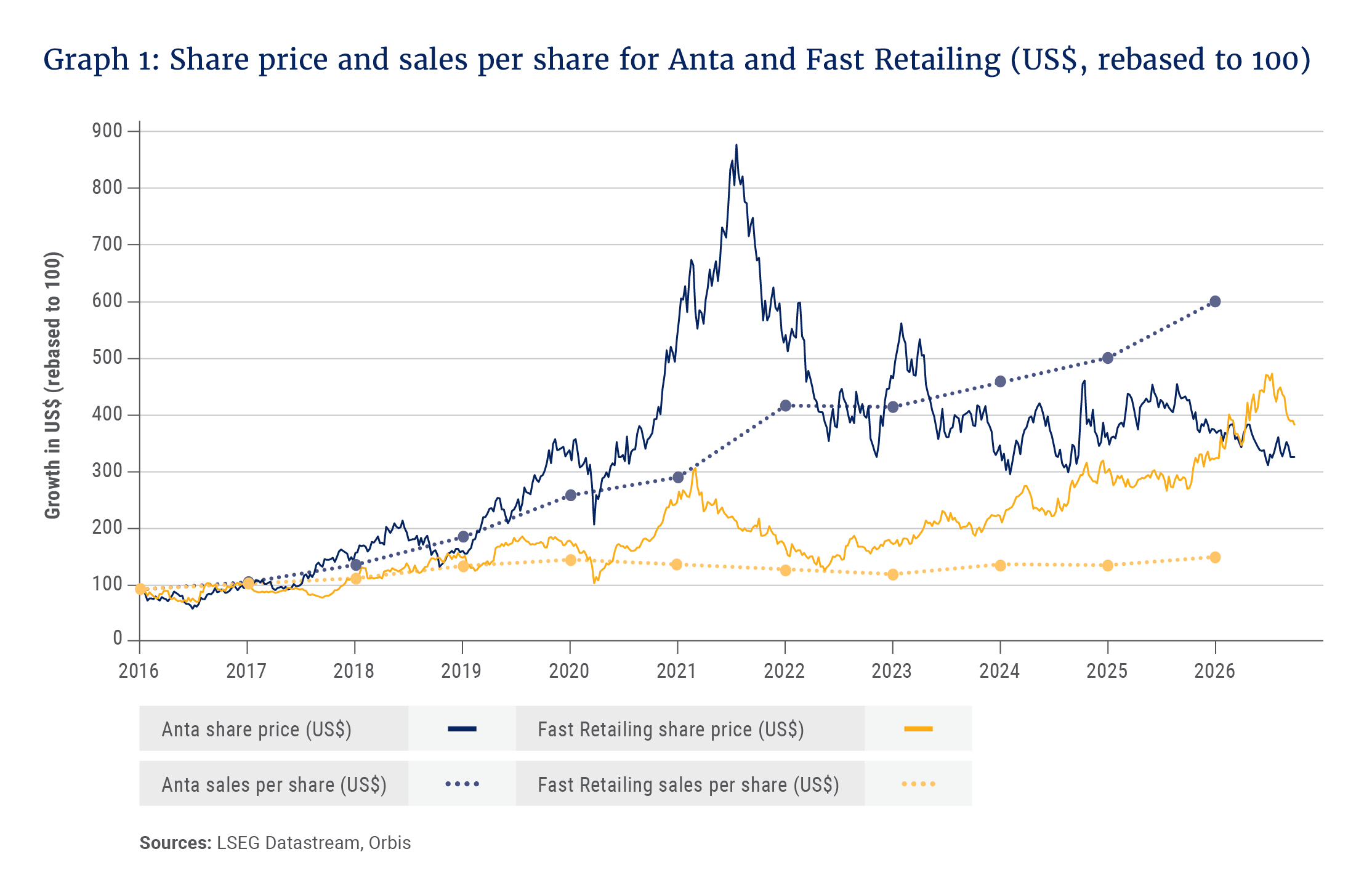
Some “China discount” is justified, but it does not change Anta’s operational and financial track record. Given time, we expect Anta to successfully navigate this cycle, as it has earlier ones. Earnings should continue to compound and drive a reappraisal of its multiple to recognise its quality, providing substantial upside from today’s price.
Vivienne Westwood, the British fashion designer, advised, “Buy less. Choose well. Make it last.” Wise words for buying clothes and for investing in clothing companies. Anta qualifies on both counts.
Nintendo vs. LEGO
Few would dispute that LEGO is the GOAT of toys. Its name is an abbreviation of the Danish phrase “leg godt”, meaning “play well”, a theme that runs through everything it does. Founded in 1932, it originally sold wooden toys, survived two factory fires, switched to plastic toys and reinvented itself with the interlocking bricks. Four generations of the founding family later, it is the world’s largest toy company by revenue and has been named “Toy of the Century” by both Fortune magazine and the Toy Retailers Association (formerly the British Association of Toy Retailers).
LEGO sells plastic bricks, but its real product is imagination. A single brick does little on its own, but combined with others, it allows people to build endless creations. This system of play has proved timeless, enabling LEGO to remain popular for decades in an industry known for short-lived fads.
LEGO is privately owned, so we cannot own it. We can, however, look for a company that has a similar set of characteristics.
Holding games back until they meet Nintendo’s quality bar is the hallmark of a long-term mindset ...
Nintendo predates LEGO and was founded in 1889 in Kyoto. It originally sold Japanese playing cards, then tried everything from taxis to instant rice before focusing on what it is known for today – high-quality, long-life video games such as Donkey Kong, Super Mario and Zelda.
As with LEGO, the Nintendo experience matters as much as its products. Nintendo’s philosophy is well captured in the way it describes the Switch 2 experience, creating moments to be enjoyed “all together, anytime, anywhere” with an appeal that spans cultures and generations. Quality and consistency come first with management prioritising the integrity of Nintendo’s characters and the players’ experience over short-term targets. Unlike other gaming companies, it has kept control of its ecosystem, allowing it to design hardware and software that work seamlessly together and extend its characters into other areas such as theme parks and films. The Super Mario Bros. Movie, whose box office success helped boost sales across the Mario franchise, is a good example of how success in one format can deepen fans’ connection with the Nintendo characters and reinforce interest in its games.
We have owned Nintendo for several years. The shares did well initially as investors came to appreciate its intellectual property and the successful release of its new Switch 2 console, but sold off recently on earnings pressure from a delayed game release schedule and the rising cost of the memory chips used in its consoles. We see both as short-term noise. Holding games back until they meet Nintendo’s quality bar is the hallmark of a long-term mindset, and memory is expensive because of extreme demand from AI data centres. Both should normalise over the coming years. We are patient owners while they do.
Greggs vs. Ikea
As with LEGO, many would consider Ikea the GOAT of furniture. Founded in 1943 by Ingvar Kamprad, it popularised functional furniture sold in flat-packed boxes and assembled at home. It is now the largest furniture retailer in the world.
... we view owning Greggs shares as remarkable value for money.
Ikea’s vision is “to create a better everyday life for the many people” by offering “a wide range of well-designed, functional home furnishing products at prices so low that as many people as possible will be able to afford them”. It does this by balancing price, quality and function. Ikea’s first rule, “to maintain an extremely low level of prices”, matters as much as their approach to quality, where they believe “throw-away products are not Ikea”. Products often start with a defined function and a target price, and are then engineered backwards to meet these goals, epitomised by the one-euro LED light bulb.
Greggs appears to be a very different business to Ikea, but it comes from similar humble beginnings. Founded in 1939, it began with John Gregg delivering fresh eggs and yeast by bicycle to families around Newcastle in the north of England. It is now the UK’s leading seller of food-on-the-go. It is famous for its sausage rolls, selling more than 100 million a year.
Patience, consistency and a long time horizon let us own businesses that compound wealth.
Greggs’ purpose is to make “great-tasting and freshly prepared food that’s accessible to everyone”, surprisingly similar to Ikea’s vision of a “better everyday life for the many people”. Both are synonymous with value for money. They do this by constantly investing in and simplifying their business to minimise costs. Greggs’ food is typically priced well below its food-on-the-go peers and on a par with grocery stores. A regular Americano, for example, is around 30-40% cheaper than at Pret A Manger or Starbucks.
Greggs’ secret weapon is their supply chain. They sell a high volume of a few simple products. Most are made in its own central bakeries, transported frozen, delivered once daily to the shops, then baked in-store and in small batches to be sold fresh to customers. Controlling the process from start to finish lets Greggs make and deliver its products with industrial efficiency, while the shops create the smell and experience of a local bakery.
The similarities with Ikea go deeper. Both treat affordability as part of their purpose, retain their original regional identity and believe that prioritising customers and employees helps rather than hurts shareholder returns. Greggs remains headquartered in its founding city, Newcastle, with simplicity and humility core to the company. “Greggs is for everyone” explicitly puts customers and staff first. It has shared 10% of profits with employees for decades.
Ikea is privately held, but Greggs is publicly listed and we are enthusiastic owners of its shares. Many global investors ignore Greggs, viewing it as an ex-growth company at the mercy of the weak macroenvironment in the UK. We view it as a best-in-class operator, priced at an attractive multiple of earnings, paying a healthy dividend, with profit growth that should accelerate as its supply chain investments are completed.
Much like Ikea’s furniture or Greggs’ sausage rolls, we view owning Greggs shares as remarkable value for money.
Common lessons
Great companies share common lessons. Their success takes decades to unfold. They experience setbacks along the way. They put customers first. They stay humble and true to their guiding principles. They keep reinvesting in their business.
Investing is similar. Patience, consistency and a long time horizon let us own businesses that compound wealth. We are particularly excited when we can own companies that remind us of the greats, but are not priced as such. Anta Sports, Nintendo and Greggs fit that mould. Like the rest of the portfolio’s holdings, we believe they are underappreciated, undervalued and have the potential to exceed expectations over the coming years.
- 2026 Q3 Comments from the Chief Operating Officer by Mahesh Cooper
- Changing offshore investment limits: A solution looking for a problem by Sandy McGregor and Mattew Patterson
- Navigating setbacks and successes at Sun International by Pieter Koornhof
- The overlooked side of long-term compounding by Thandi Skade
- The patience paradox: The challenge of long-term investing by Daniella Bergman
- A belief that business can and should be a force for good by Mahesh Cooper
- Long-term lens: Seeing through the smoke and mirrors by Simon C. Marais
To view our latest Quarterly Commentary or browse previous editions, click here.