
Since the late 1990s, Allan Gray clients have held positions of varying size in Sun International, a casino and resort operator founded in 1967. Over nearly three decades, the long-term investment case has evolved repeatedly as the company achieved great successes, suffered nearly fatal challenges, and reinvented itself. Pieter Koornhof discusses how Allan Gray’s views on the company have changed over time and shares the lessons long-term investors can learn from this journey.
In a 2001 Quarterly Commentary article, Simon Marais, Allan Gray’s chairman at the time, discussed the different ways in which a company’s accounting earnings may not be an accurate reflection of its true earnings power. This can be true to both the upside and the downside. Indeed, complexity, frequent acquisitions, and the (often) wide discretion afforded by accounting standards are sometimes abused to present a company’s financial results in an overly optimistic light.
However, as Simon eloquently explained, the opposite can also be true: “Accounting conventions can sometimes also understate the true value of a company and thus offer attractive investment opportunities.” Simon pointed to Sun International as an example of such an opportunity.
We have republished his full article as part of this Quarterly Commentary for ease of reference. You can also view the full Q3 2001 Quarterly Commentary here.
Opening bids
Back in 2001, Sun International was investing significant capital to build several brand-new casinos, resorts and hotels. The capital expenditure was incurred upfront and in cash. However, accounting standards required that this expenditure be recognised as an expense called “depreciation”, which is deferred over many years in the company’s accounts. This mismatch between the upfront cash expenditure and deferred accounting expense was crucial as the reported accounting earnings were understating Sun International’s true earnings power. The company’s accounts were further complicated by two additional factors:
- While under construction, the new assets were not generating income, but once completed, would start generating revenues, providing a further boost to Sun International’s cash earnings.
- Sun International had taken on a large amount of debt to fund the construction of these assets and, as a result, had to make large interest payments. Once the new assets opened, the new revenues could enable rapid repayment of the debt, further boosting earnings growth as the interest charges fell away.
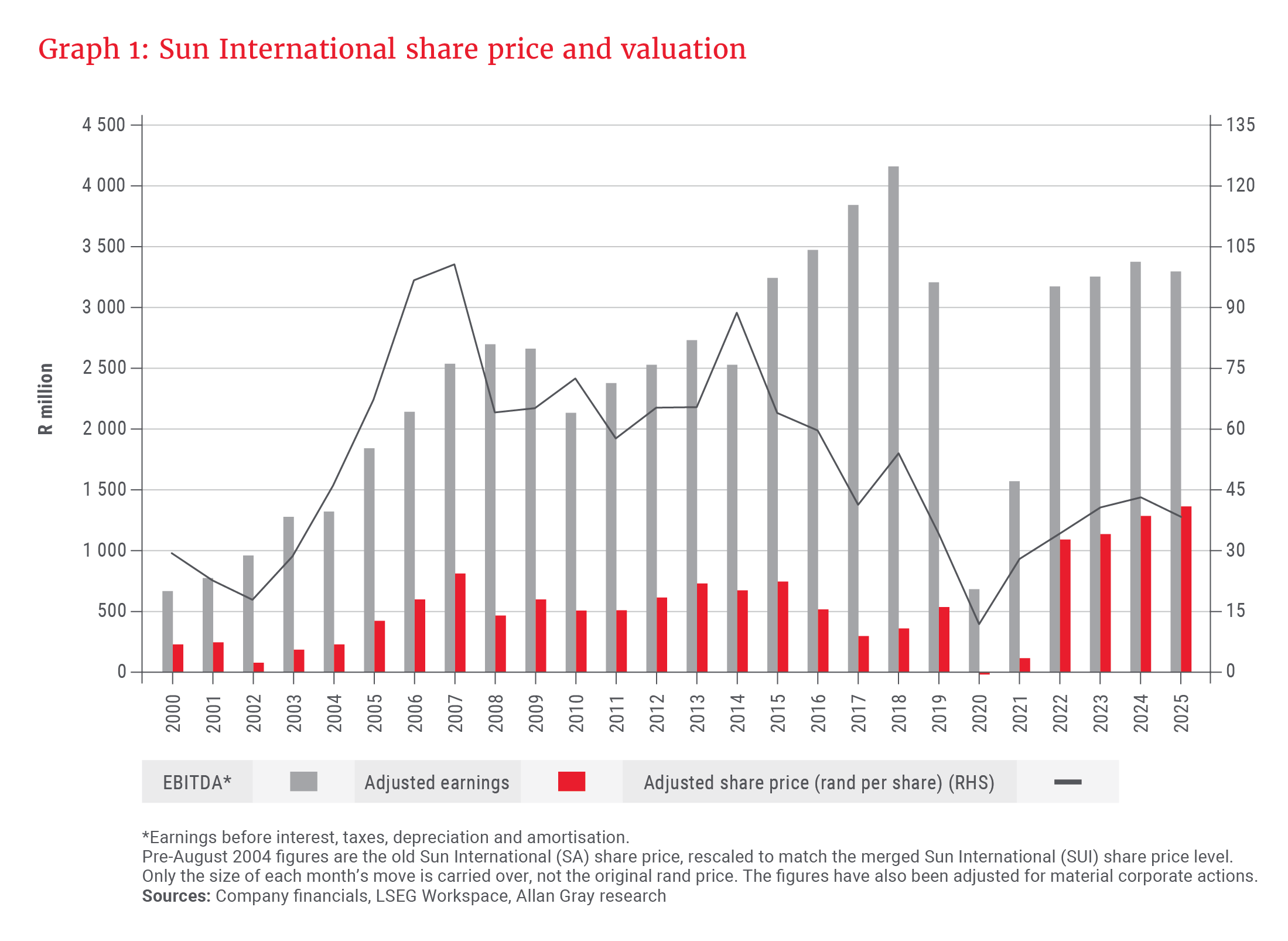
These factors meant that Sun International was well positioned for its cash earnings to grow rapidly over the coming years and to far exceed its accounting earnings. The market underappreciated this, enabling Allan Gray to build a material position in Sun International at a cheap valuation on behalf of its clients. Simon’s insight proved to be correct: Sun International’s share price rose from R30 per share at the time of his article to over R100 per share by 2007, as shown in Graph 1.
Double or nothing
After the highs of 2007, Sun International underwent a tough period that highlights two further investment lessons:
- Simon pointed out that “companies that manage to grow their earnings faster than inflation over long periods are invariably good long-term investments. Yet no company can do this consistently.” In investing, there is no room for complacency as even a fast-growing company requires constant reassessment. Competition, technology, regulatory changes, macroeconomic shifts and a host of other risks can derail a company’s growth trajectory.
- Growing earnings is important, but how such earnings are applied or reinvested by a company’s management team is often just as important. This decision is called “capital allocation”. Allan Gray’s investment process includes detailed analysis of the management team’s capital allocation skill and track record when investing in a company.
By 2019, Sun International faced several external challenges and had scored some own goals, causing the share price to fall from a peak of over R130 per share in 2007 to roughly R40 per share. Revenue growth at its casinos had slowed as weak economic growth in South Africa put pressure on consumer expenditure, gambling lost share to goods, services and other leisure activities, and the hotel market was oversupplied following the 2010 FIFA World Cup boom. Sun International’s management had also spent the high earnings generated in the 2000s and taken on considerable debt to invest in acquisitions and projects that destroyed value and/or generated disappointing returns. These included:
- Building and acquiring hotels, resorts and casinos in several African and Latin American countries that underperformed for a variety of reasons
- Investing too much capital to renew the licences and/or exclusivity of underperforming assets such as the Boardwalk Casino in Gqeberha and The Maslow in Johannesburg
- Investing too much capital to build its new Time Square Casino in Pretoria
- Overcapitalising underperforming resorts such as Sun City
“You’ve got to know when to hold ‘em, know when to fold ‘em.” – Kenny Rogers, “The Gambler”
Sun International was already on the back foot due to the headwinds described above. Then in 2020, the COVID-19 pandemic hit. South Africa had especially harsh lockdowns with casinos, resorts and hotels remaining shut for many months. Sun International’s revenue dropped to almost zero overnight, but it still had to incur fixed costs, including wages, essential maintenance and the interest on its sizeable debt load. Its debt peaked at R15.0bn in June 2020 – more than 200 times its earnings before interest, taxes, depreciation and amortisation (EBITDA) at the height of the pandemic. For context, companies like Sun International usually keep their debt below 3.0 times EBITDA, so these were truly exceptional circumstances.
In investing, there is no room for complacency as even a fast-growing company requires constant reassessment.
The market began pricing in Sun International going into financial distress. Its share price fell to a low of R11 per share in May 2020 and its market capitalisation (i.e. the total market value of all its shares) fell to a low of R1.1bn, down from a peak of R17.4bn in 2007 and from R5.5bn at the end of 2019.
It is easy to forget that in mid-2020, it was still highly uncertain how long lockdowns would last, whether an effective vaccine would be found, and what the recovery trajectory would look like, especially for travel, leisure and public spaces. At the time, our Investment team was doing frequent projections of companies’ cash burn and debt levels to work out how many months they could survive in lockdown before going bankrupt.
In June 2020, Sun International announced a R1.2bn rights issue at R9 per share, which was funded by its shareholders, including Allan Gray clients. This infusion of liquidity would buy the company enough time to ride out an extended lockdown, give its bankers enough headroom to extend the repayment terms and relax the covenants on its debt, and allow it to continue paying wages and other fixed costs.
... its management made a very savvy investment that is likely to define the company over the next decade.
Duncan Artus, our current chief investment officer, presciently noted in a 2014 Quarterly Commentary article on Sun International that “when a company or industry goes through a prolonged difficult period, change invariably comes about”. Many of the changes needed to restore Sun International to growth were already underway when COVID-19 hit, although these had taken longer than expected to materialise. However, the COVID crisis gave Sun International renewed impetus to reshape the company. This included:
- Cutting a material portion of the cost base
- Exiting the African and Latin American operations at decent prices
- Restructuring smaller underperforming casinos
- Investing sensibly to refresh some assets that had favourable long-term prospects
The road to recovery was rocky, partly due to the reimposition of several rounds of lockdowns and continued severe restrictions on operations for a few years after the initial lockdown was lifted. Despite this, the rights issue proved to be a shrewd investment as Sun International’s share price recovered to over R40 per share by 2023.
Online gambling raises the stakes
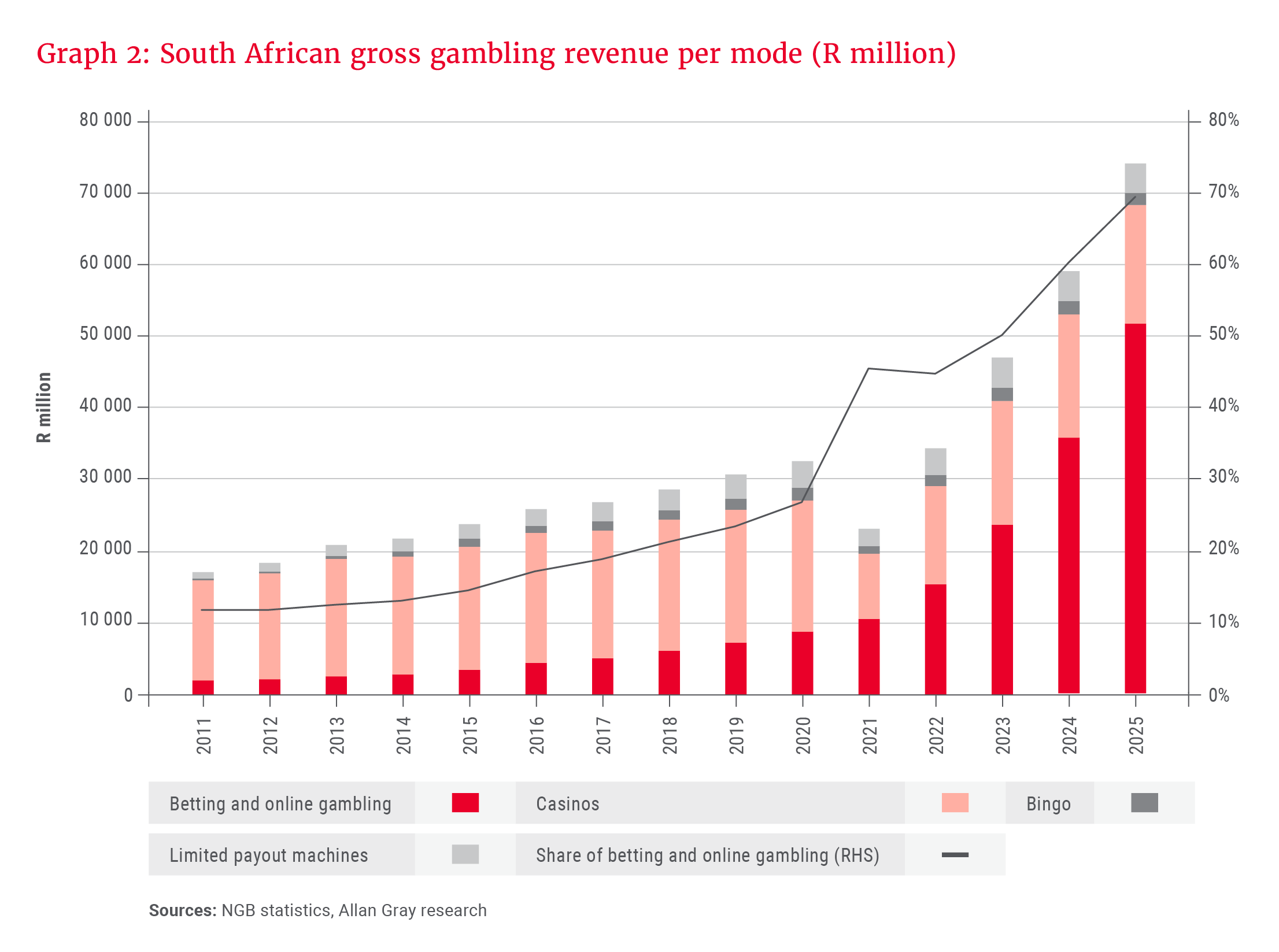
Despite these positive changes, Sun International faced a new challenge post COVID: the rise of online gambling. As shown in Graph 2, online gambling went from less than a quarter of gross gambling revenue in South Africa in 2019 to over 70% by 2025. This came as more online gambling licences became available, and as increasing smartphone penetration and COVID lockdowns drew punters to play online. Online gambling has grown the overall gambling market, but also cannibalised a sizeable portion of land-based gambling. It has also raised concerns over an increase in problem gambling and financial pressure on vulnerable customers.
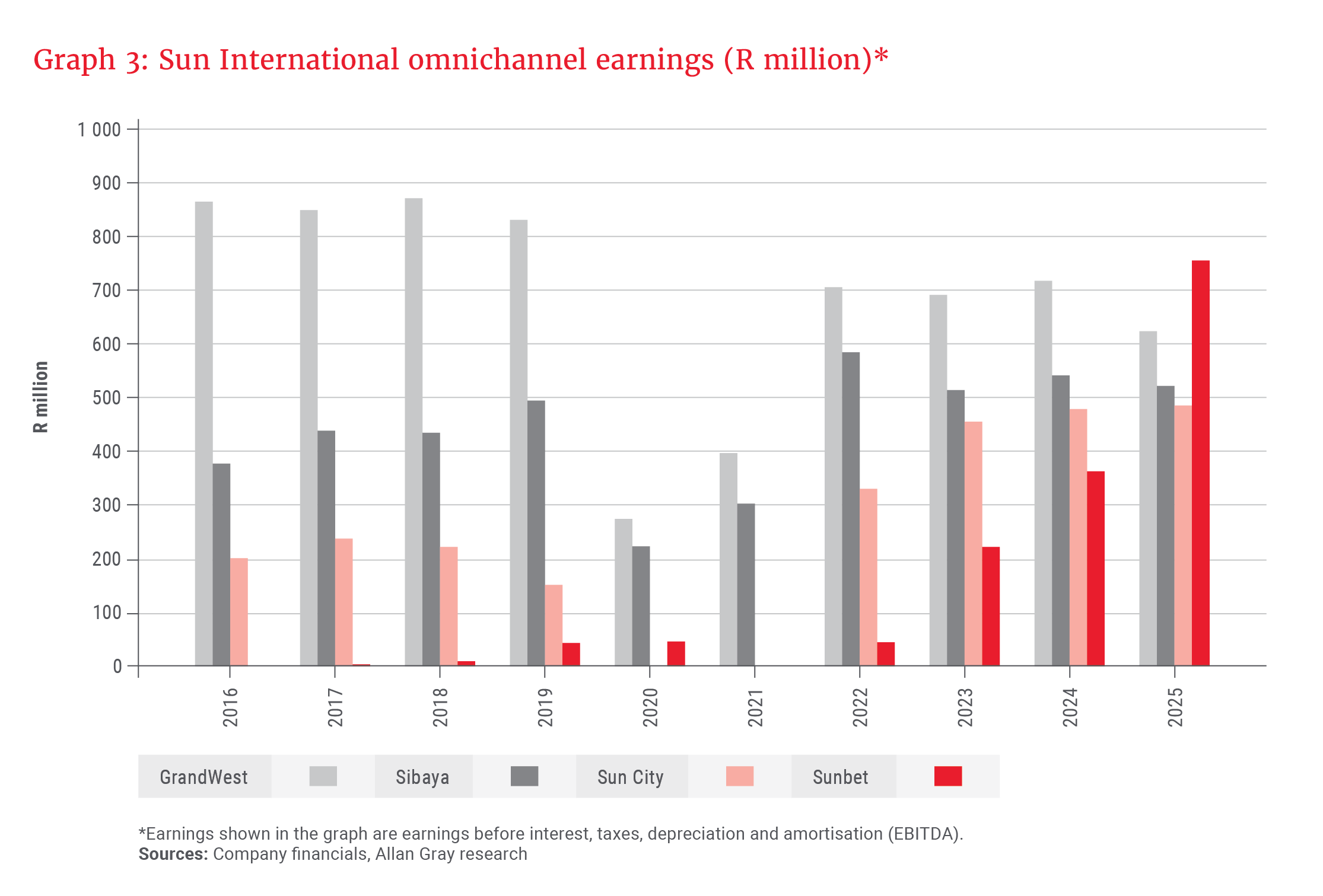
While Sun International made some capital allocation mistakes in the 2010s (as discussed earlier), its management also made a very savvy investment that is likely to define the company over the next decade. They were early to see the potential of online gambling in South Africa and accordingly invested to grow Sunbet, Sun International’s online gambling offering. While it took some time to gain traction, Sunbet is now Sun International’s largest asset by earnings, as shown in Graph 3. It is well positioned to continue its rapid growth in the coming years. This is enabled by its differentiated product offering: It typically caters to a wealthier demographic than other online betting providers and leverages Sun International’s land-based casinos to provide an omnichannel offering.
After the explosive growth of the last few years, regulatory changes are also coming to online gambling. These are yet to be finalised, but are likely to include advertising restrictions, a national online gambling tax and moving licensing from provincial gambling boards to a national one. These changes could be very disruptive, and a fine balance has to be achieved. If online gambling taxes are pitched too high, they risk driving customers into illegal channels, where they have less protection, while also costing the fiscus billions in lost tax revenue.
If they are set too low, they incentivise more entrants and higher marketing spend, which can increase problem gambling, and disadvantage land-based casinos, which are typically larger employers. The online gambling industry is still in its infancy in South Africa, and significant changes are likely in the coming years as it matures.
Shuffle and deal again
Sun International again finds itself at a pivotal moment in its history. Ulrik Bengtsson took over as CEO in 2025 and has a strong background in both online and land-based gambling. He has laid out a bold omnichannel strategy, which includes investment in technology and new products to gain further market share online and drive synergies between Sunbet’s online offering and Sun International’s land-based casinos and resorts. The company is again investing heavily upfront to deliver this strategy. It therefore finds itself in a position reminiscent of 2001, namely where its accounting earnings may not be an accurate reflection of its true earnings power due to the high current level of investment.
Sunbet is well positioned to continue its rapid growth in the coming years.
History is not necessarily destined to repeat itself (if only investing was so easy!) and circumstances are very different from what they were in 2001. As a start, Sun International’s balance sheet is healthy, with net debt of less than 2.0 times its EBITDA, and it is not chasing offshore acquisitions. On the other hand, the omnichannel strategy it is pursuing has had varying degrees of success in other jurisdictions, so it remains to be seen how it will fare in South Africa. Sun International will also have to ensure that its land-based casinos and resorts remain relevant to customers in an increasingly digital world. In the coming years, we will see if the house always wins.
- 2026 Q3 Comments from the Chief Operating Officer by Mahesh Cooper
- Changing offshore investment limits: A solution looking for a problem by Sandy McGregor and Mattew Patterson
- The overlooked side of long-term compounding by Thandi Skade
- Orbis Global Balanced: The quiet compounders by Mark Dunley-Owen
- The patience paradox: The challenge of long-term investing by Daniella Bergman
- A belief that business can and should be a force for good by Mahesh Cooper
- Long-term lens: Seeing through the smoke and mirrors by Simon C. Marais
To view our latest Quarterly Commentary or browse previous editions, click here.