
Locally listed gold miner Pan African Resources has long been one of our preferred exposures to the gold sector, and it has been a golden goose for our clients, delivering returns far in excess of the market since its listing. Andrew Boulton sifts through the gravel to reveal what glimmers beneath the surface.
To paraphrase veteran investor Warren Buffett, superior long-term wealth is often built by owning the goose that lays the golden eggs, rather than the golden egg itself.
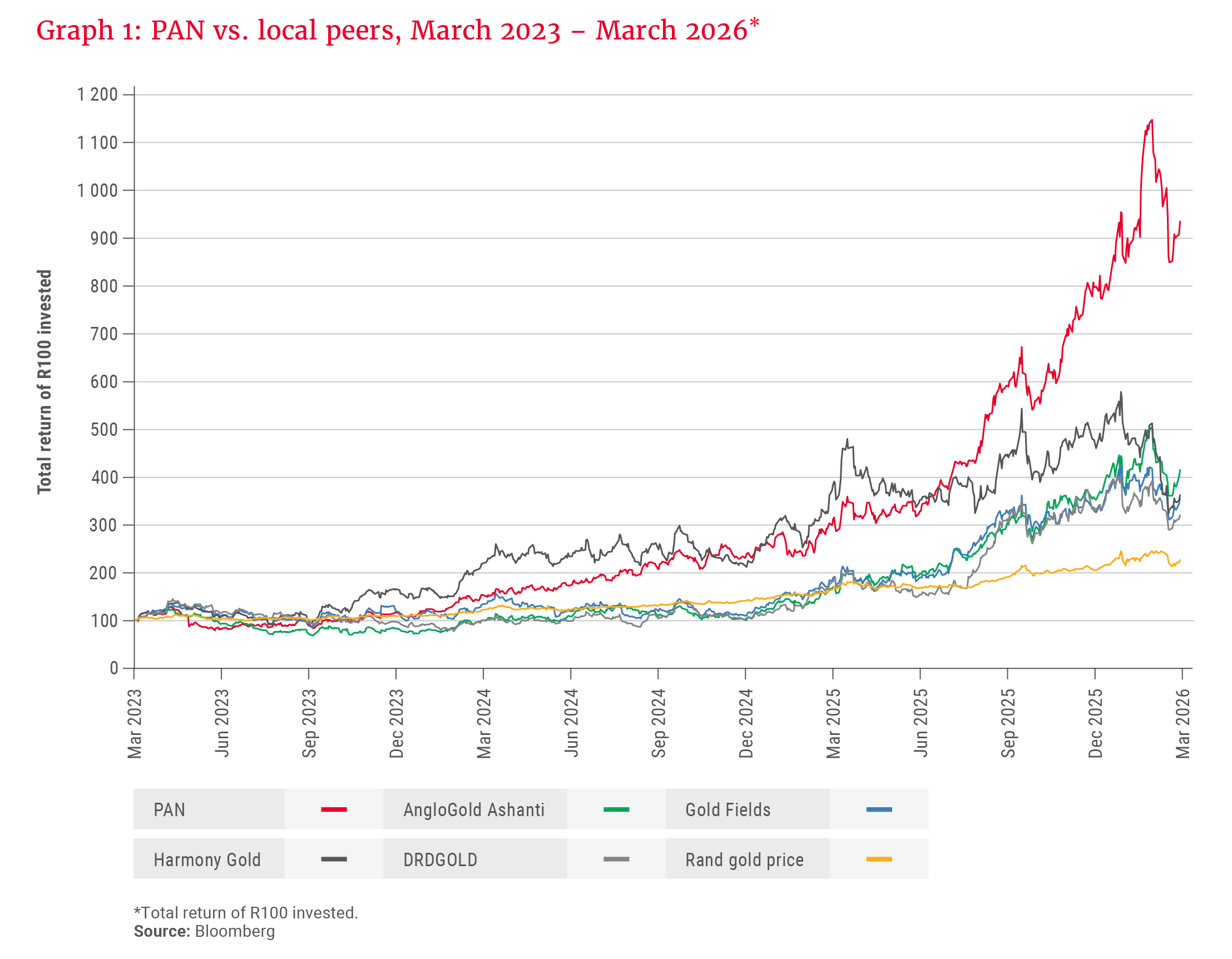
Pan African Resources (PAN) has been nothing short of a golden goose for our clients: Over the past three years, PAN shares have increased in value from R3.68 per share (end March 2023) to R31.50 per share at the time of writing (end March 2026) – an approximate ninefold return, including dividends reinvested. That is equivalent to a compounded return of 108% per year over the last three years.
… we continue to watch PAN’s journey into its new Australian territory with great enthusiasm, and we expect PAN to continue delivering more golden eggs in the future.
While higher gold prices have provided a tailwind for all gold miners, PAN has been the top performer within the group, far exceeding the total returns of its locally listed gold-mining peers, as shown in Graph 1.
Over the longer term, shareholder returns have also been impressive. Since listing on the JSE in 2007, PAN has delivered a total return of approximately 50-fold (including reinvested dividends), or a compounded return of 23% per year over 19 years. This is significantly higher than the market’s average return of 11% per year over the same time frame. How exactly have they done this?
The secret sauce: Turning waste into gold
PAN listed on the JSE after acquiring a Barberton gold-mining complex in South Africa. This included a group of conventional underground mines that have operated since the 1880s, producing around 80-100 thousand ounces (koz) of gold per year at the time of acquisition.
While further exploring the Barberton complex, PAN identified a distinct opportunity that would later shape the future of the company: reprocessing gold tailings dumps.
Tailings dumps typically refer to waste stockpiles generated by historical gold processing. These often contain significant amounts of low-grade gold, partly due to the inefficient historical recovery methods. Advances in technology, combined with in-house technical expertise, allowed PAN to extract this gold at favourable economics.
An additional benefit of the strategy was its positive impact on society ...
A key advantage of the tailings strategy was its largely mechanised nature, which allowed for a lower-cost production profile relative to that of most other conventional mining methods. An additional benefit of the strategy was its positive impact on society: Reprocessing historical waste sites enabled land rehabilitation, improving the environment for future generations. A win-win scenario for all stakeholders.
Rinse and repeat
Following the success of its Barberton Tailings project in 2013, PAN replicated its tailings strategy with a series of strategic acquisitions and delivered many golden eggs in the process:
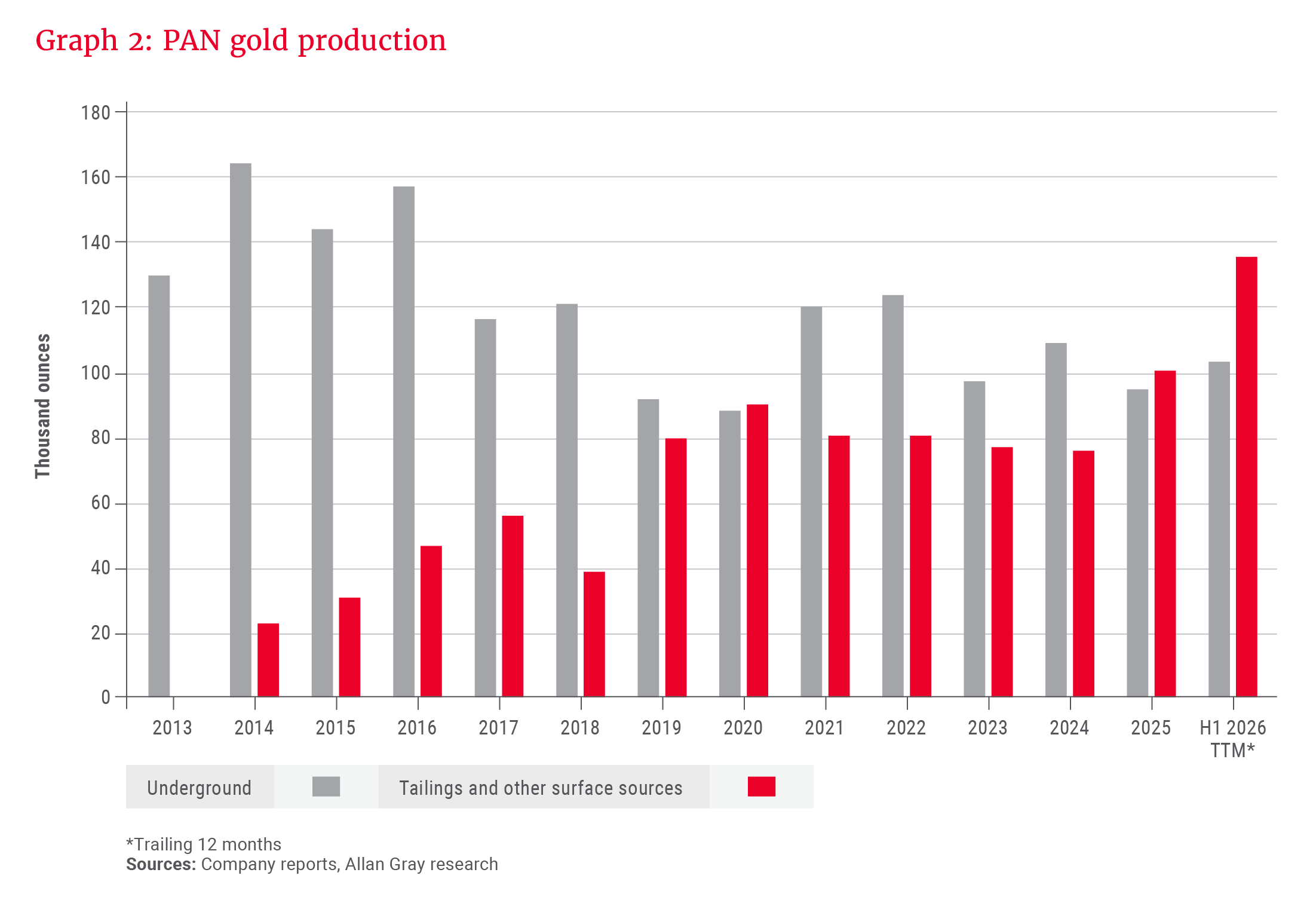
- 2013-2018: PAN acquired the historical Evander mines and successfully deployed its tailings strategy, this time having access to larger tailings dumps. While Barberton tailings only produced around 20 koz of gold annually, Evander tailings produced around 50 koz of gold per year since 2018.
- 2023: PAN deployed its tailings strategy again after acquiring the historical Mogale tailings dumps, producing around 50 koz of gold over the trailing 12 months reported.
- 2025: PAN acquired the historical Tennant Creek mining complex (TCMG) located in Australia, and is once more deploying a similar strategy.
As a result, the increase in gold produced by PAN from tailings has been so significant that it now exceeds the amount of gold produced from underground mines, as shown in Graph 2.
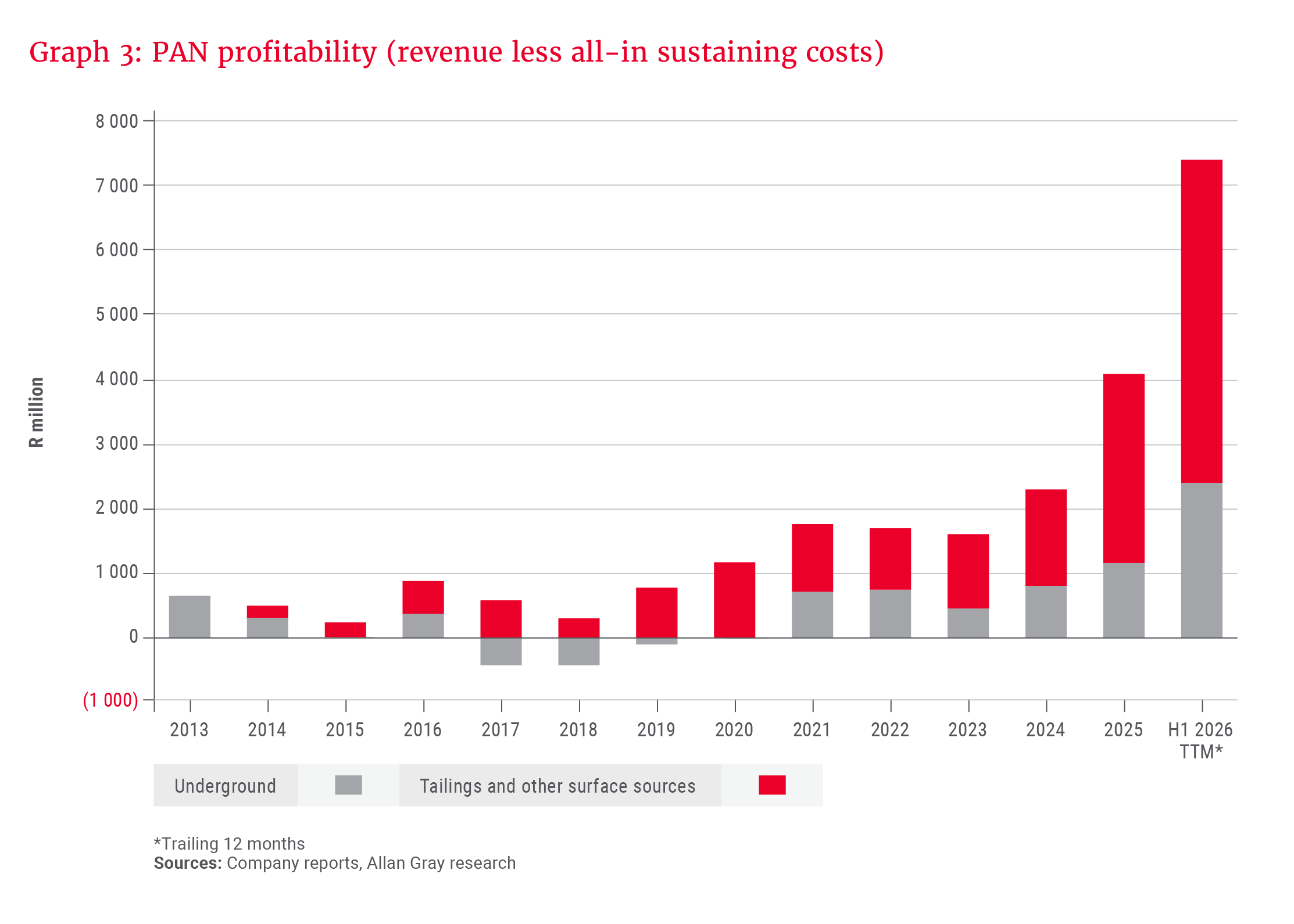
Given that production from tailings is lower-cost, it generates a higher profit per ounce of gold and improves PAN’s overall profitability, as illustrated in Graph 3. Including the production from TCMG (guided to be around 50 koz), PAN is expected to further increase its gold production from tailings and other surface sources over the next year.
The Lollapalooza effect
Charlie Munger, Buffett’s long-term business partner, introduced the term “Lollapalooza” to describe scenarios where multiple forces act in concert to produce an extreme outcome. Over the last three years, PAN’s extreme returns have emerged from a Lollapalooza scenario:
PAN’s growing production from lower-cost tailings ounces + leverage from the higher gold prices = an approximate ninefold return over three years
Our clients have benefited from these spectacular returns, as our long-term investment philosophy and continuous assessment of bottom-up company fundamentals have led us to maintain exposure to PAN since 2009. A Lollapalooza for our clients.
As we have realised some of these gains on behalf of our clients, our holdings of PAN’s shares in issue have reduced (in percentage terms). However, our clients’ notional exposure (in billions of rands) is still higher than a year ago.
Our clients have benefited from these spectacular returns …
Golden opportunities?
While we don’t pay much attention to the short-term fluctuations of the gold price, we do continue to watch PAN’s journey into its new Australian territory with great enthusiasm, and we expect PAN to continue delivering more golden eggs in the future.
For readers interested in our longer-term views on gold, see our previous gold-related articles, available via our “Latest insights” page, and listen to episode 28 of The Allan Gray Podcast, “Gold in the age of fiscal dominance”.
Explore more insights from our Q1 2026 Quarterly Commentary
- 2026 Q1 Comments from the Chief Operating Officer by Mahesh Cooper
- Investing through disruption: Lessons from history for the age of AI by Nshalati Hlungwane
- Dis-Chem: A great business at a great price? by Jonty Fish
- Higher discretionary allowance: The opportunity to invest more offshore by Daniel van Andel
- Orbis Global Equity: The art of adaptability in turbulent markets by Ben Preston
- Mind the gap by Horacia Naidoo-McCarthy
- Maximising new tax benefits to boost long-term investment outcomes by Shaun Duddy
To view our latest Quarterly Commentary or browse previous editions, click here.