
Artificial intelligence (AI) has the potential to transform industries and improve living standards, yet it continues to raise profound questions about employment, misinformation and information integrity, data governance and systemic risks. The impacts – both positive and negative – are rarely binary. As investors, we seek to evaluate these issues holistically. Against this backdrop, Emily Gray examines the implications of AI adoption on work, opportunity, trust and long-term economic resilience.
Debates about AI often focus on its potential to accelerate economic growth and its capacity to disrupt work. Both are important, and signs of their impact are beginning to emerge. But the implications run deeper than headline projections of productivity gains or job losses. AI will influence how work is organised, how opportunity is accessed, and how trust is maintained in the information around us. These are social as well as economic outcomes, and the speed of AI adoption in everyday life is compressing the adjustment.
Shifts in early career development and learning
Today’s AI systems are unlikely to displace entire occupations at once. Instead, they are reshaping work hours as certain tasks become more efficient. By some estimates, existing AI-powered technologies could, in principle, perform activities accounting for more than half of work hours in economies with a high share of professional, administrative and other “knowledge-based” roles. This does not imply that more than half of jobs will disappear, but it does point to a significant reorganisation of work and the way skills are developed across careers.
Several routine tasks that once formed part of early learning for junior staff can now be completed by more experienced staff using AI tools, reducing the volume of routine work delegated down the organisational ladder. Although South Africa’s economy is less concentrated in knowledge-based roles than many advanced economies, in our already-fragile labour market, where youth unemployment remains high, changes in entry-level opportunities may make it harder for young people to secure stable work, while businesses benefit from greater efficiency.
At the same time, this does not necessarily imply weaker development opportunities. As AI absorbs routine components, junior roles may involve earlier exposure to more complex and interesting work. In this sense, AI is likely to change how experience is built, rather than uniformly reducing the opportunities to acquire it.
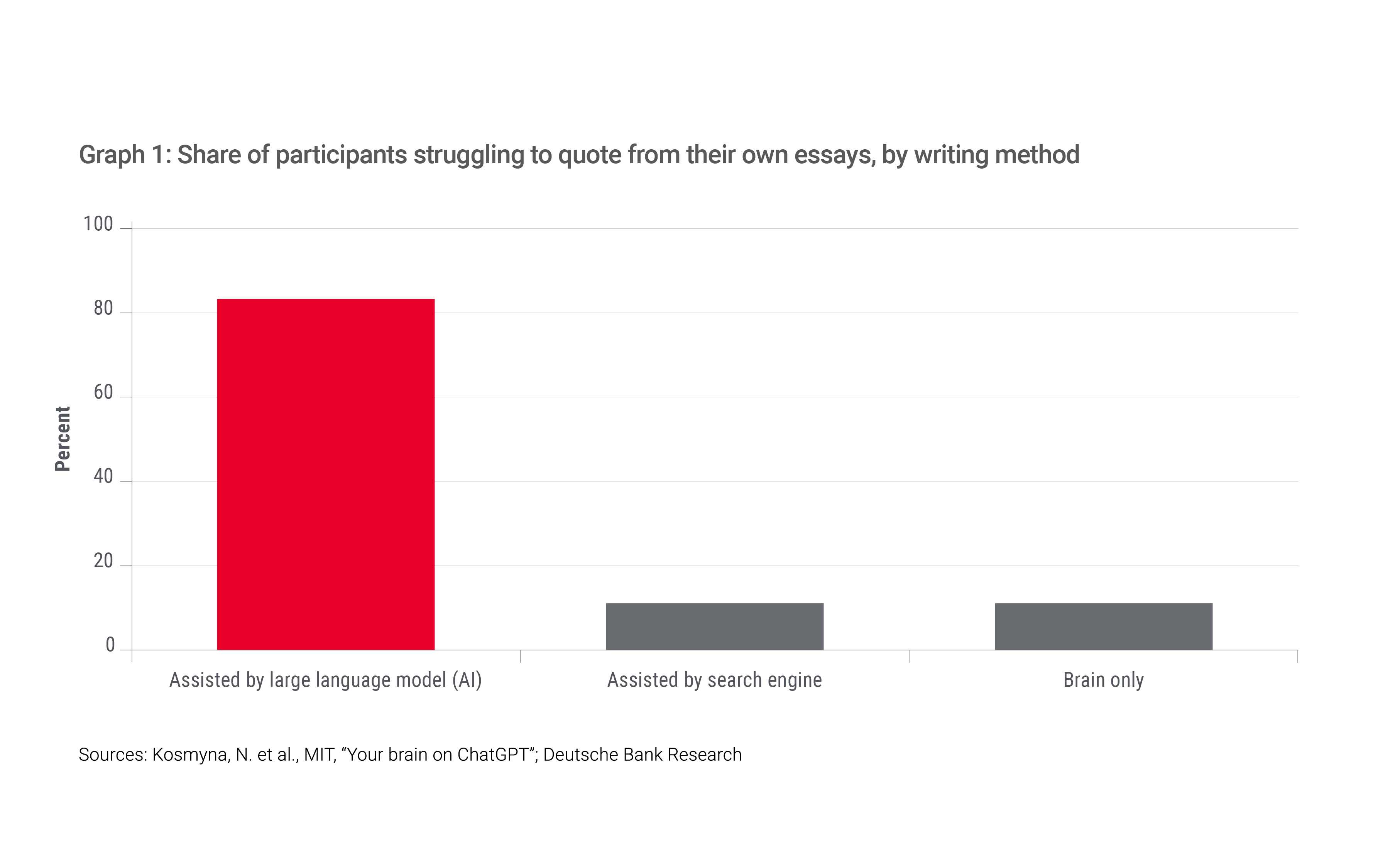
When it comes to learning both in formal education and at work, conversational AI has effectively placed a powerful tutor in our pockets. In countries like South Africa, where teaching resources are stretched and access to individual learning support is highly unequal, this can be transformative. However, it also raises questions about cognitive development and independent thinking. Graph 1, drawn from a small study by the Massachusetts Institute of Technology (MIT), suggests that participants who relied heavily on AI to write an essay showed significantly lower recall than those who did so unaided, with the researchers also noting lower levels of cognitive engagement. These early findings invite reflection on how the widespread use of AI tools may shape the foundations of effort, learning and retention across society over time.
Demographic realities and economic responses
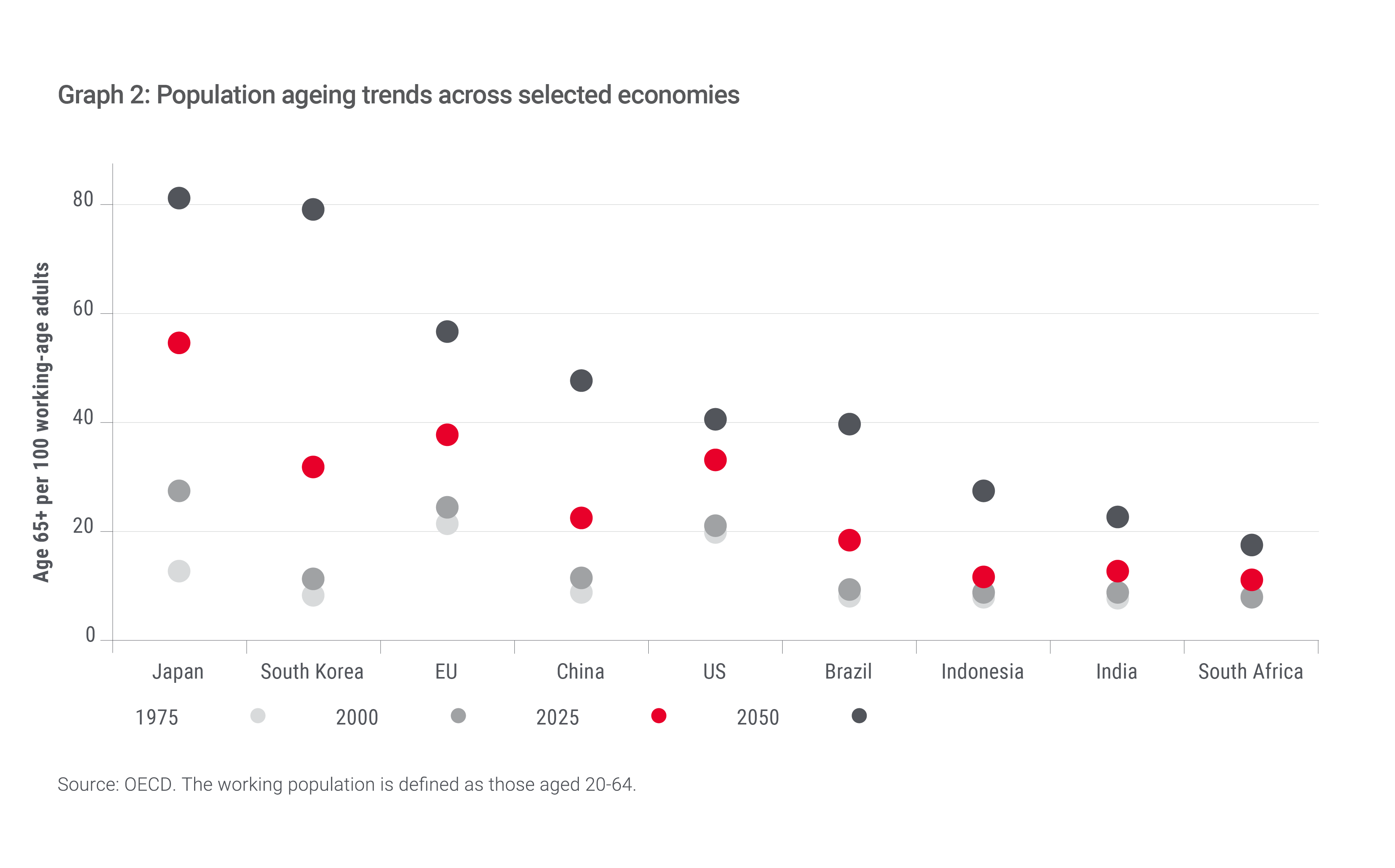
The way these shifts unfold will also depend on underlying demographic realities. In many advanced economies, the dominant structural challenge is ageing, reflected in a declining share of working-age people as populations live longer and fertility rates decline. With fewer workers available to sustain economic activity, automation and AI can be seen as practical tools of response.
As depicted in Graph 2, South Africa’s youthful population puts us at a very different point on the demographic transition. Our challenge in the AI era – as it has been for some time – is not too few people to work, but too few jobs to absorb job seekers. Over a decade of lacklustre economic growth, ongoing structural constraints and a persistent skills mismatch have limited our economy’s capacity to generate secure employment. AI now adds another layer to this dynamic.
Labour markets may also be impacted by the improvements in automation and AI tools that are changing how new businesses form. Solo Founders, a community that supports entrepreneurs starting companies alone, highlights this trend using data on US start-up activity from Carta, a platform that manages equity for private companies. The data shows that the share of solo-founded start-ups has risen from 24% in 2019 to 36% by mid-2025. It also shows that solo-founded start-ups are taking longer to make their first hire, with the median rising from 262 days in 2019 to 399 days in 2024 – a 52% increase.
This pattern is consistent with founders’ growing ability to use AI tools to extend their capacity, and it is reasonable to expect that businesses will increasingly reach scale with reduced headcount. At the same time, lower barriers to entry could fuel greater entrepreneurial activity, expanding the base from which jobs are created. More broadly, an AI-driven rise in productivity for existing businesses may support new roles as others are reshaped.
History suggests that technological shifts tend to change the composition of work rather than eliminating it outright. The introduction of ATMs in the late 1960s, for example, reduced the need for routine cash-handling, yet bank employment did not collapse; instead, roles evolved and branch networks expanded with lower operating costs. Even so, the economic and social implications of the AI shift are unlikely to be evenly experienced, and the impact may well prove broader than past episodes of technological change.
Trust, consent and accountability
Trust is another emerging pressure point, as AI tools can now produce convincing text, images, audio and video at scale. This makes it easier for fabricated content to circulate and harder for audiences to judge what is reliable, including information used to form views on public issues and political choices. This places greater importance on guardrails in how these systems are designed. As AI tools are increasingly used as sources of information and fact-checking, questions arise about what data models are trained on and whose assumptions are embedded in their outputs.
Data-related concerns also extend to consent and authorship, particularly when human work is used to train AI tools that may later undermine jobs and weaken bargaining power. At the same time, conversational AI tools are facing scrutiny for their interactions with vulnerable users. Questions of legal accountability remain unresolved, including who bears responsibility when AI systems infringe rights, generate false content or cause harm.
Implications for long-term investors
The social implications of AI are not peripheral considerations for long-term investors; they will shape how economies evolve and how durable business cash flows prove to be over time.
Investment in AI infrastructure and software is substantial and ongoing. Our task is to understand where capital is being deployed and which businesses stand to benefit as AI becomes embedded across the global economy. There is an old investment adage that, in a gold rush, it is often the sellers of picks and shovels who earn steadier returns. In the context of AI, this directs attention towards companies supplying the critical infrastructure and manufacturing capacity behind the build-out, rather than focusing solely on the highest-profile beneficiaries of the current cycle. Ben Preston from our offshore partner, Orbis, offers some good examples of this in his article, Is AI a bubble, or is the best yet to come?
Successful long-term investing is not about predicting the future with precision, and with a technological shift as significant as AI, nobody really can. Instead, it is about identifying businesses with sound economics, strong management and attractive valuations that can be combined in a portfolio that performs well across a range of possible outcomes. When it comes to AI, that means considering not only technological progress, but also its influence on the social foundations that shape long-term risk and return.
For more details about our stewardship efforts, please see our latest Stewardship Report.