We are making changes to our fees
From 1 February 2027, we are making changes to the fees for certain Allan Gray funds to simplify our fee structure and make it more consistent across our fund range.
Learn more about how these changes may impact your investments.
Allan Gray and Orbis will adopt a simpler and more consistent approach to calculating performance-based investment management fees.
The fee at benchmark (or base fee), being the fee that is charged when a fund performs in line with its benchmark, will be reduced for the funds shown in the table below.
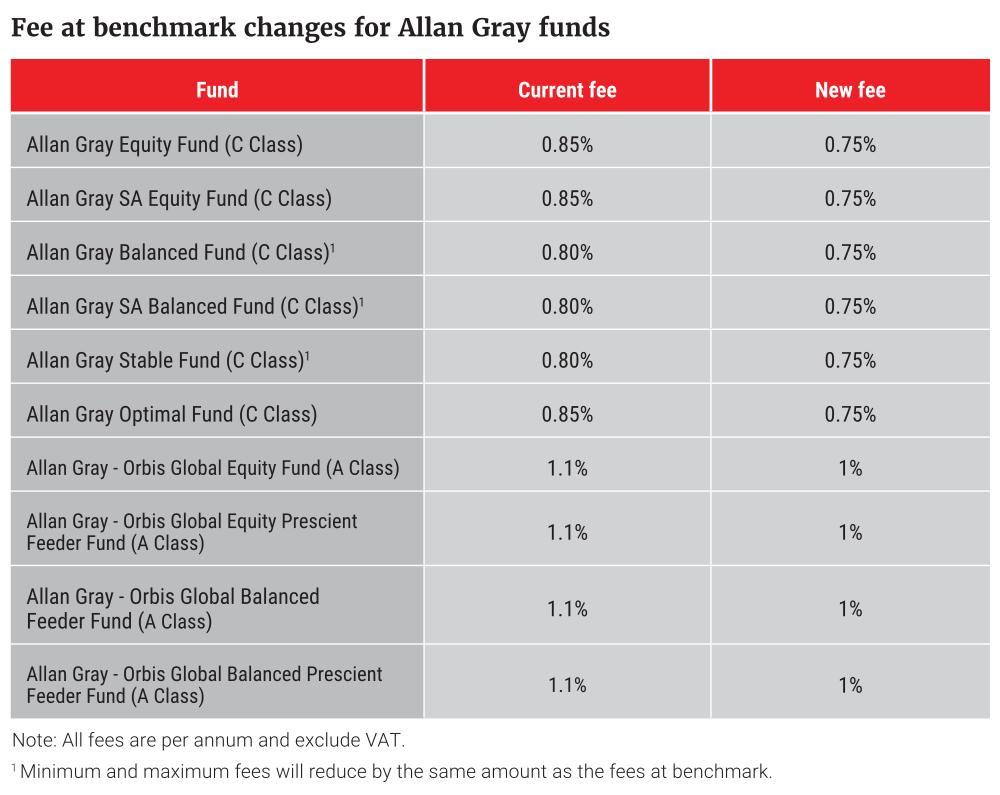
Allan Gray and Orbis’ performance-based investment management fees consist of two components:
- A fee at benchmark (or base fee), which is the fee that is charged for performance equal to the benchmark.
- A performance component, which depends on the outperformance or underperformance of the fund, after the deduction of the fee at benchmark (or base fee), relative to its benchmark (i.e. alpha).
From 1 February 2027, we will update the way performance fees are calculated in each fund to deduct the fee at benchmark applicable to each class in order to calculate the outperformance or underperformance of that class and any performance fee applicable. This approach will be consistent with Orbis.
Together, the lower fees at benchmark (or base fees) and the changes to Allan Gray and Orbis' performance fee calculation methodologies will result in you paying the same or lower average fees for most Allan Gray funds that charge a performance fee.
The exception is the Allan Gray - Orbis Global Optimal Fund of Funds. The base fee of the Fund will remain the same, however, the average fee you will pay on your investment in this fund will increase by approximately 0.06% per annum due to the change to the performance fee calculation methodology.
The Allan Gray Bond Fund, Allan Gray Money Market Fund, Allan Gray Tax-Free Balanced Fund, Allan Gray Interest Fund and Allan Gray Income Fund are not affected by these changes.